
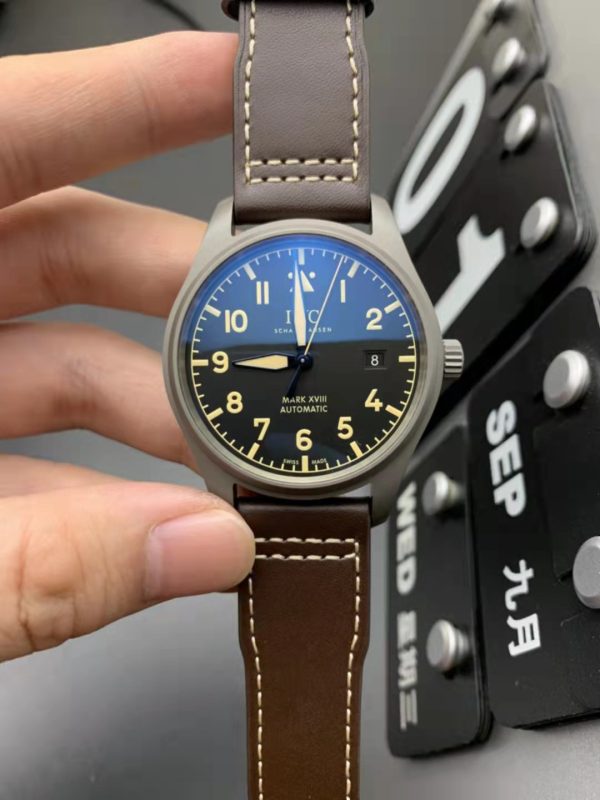
Why the V7 IWC Mark XVIII Titanium Still Feels Relevant
There was a strange period in the replica watch industry after the large factory raids and market cleanups around 2020–2021. Collectors who followed Rolex, Audemars Piguet or Patek Philippe probably still had enough new releases to discuss because Clean, VS and several other factories continued updating popular sports models in batches. But for people who genuinely liked military watches, especially IWC Pilot replicas, the market suddenly became very quiet. New projects almost disappeared. Several smaller factories vanished. Some old suppliers stopped delivering cases and dials entirely. Even Guangzhou watch market traffic started looking completely different from previous years. Many long-time dealers remember entire sections of the market becoming half-empty during that period, with fewer customers walking around and fewer fresh samples appearing on dealer tables.
That environment is exactly why the V7 Factory IWC Mark XVIII Titanium deserves more attention today than it did when it was first released. It was never designed to become a hype replica watch. It never competed in the same discussion category as Clean Daytona releases, VS Submariners or APS Royal Oaks. Instead, this was one of those quieter projects aimed at people who actually understood the appeal of older military pilot watches and wanted something understated enough to wear daily without attracting attention. Ironically, that restraint is precisely what makes this replica feel more convincing than many modern “super clone” projects filled with excessive polishing, ceramic bezels and complicated clone movements.
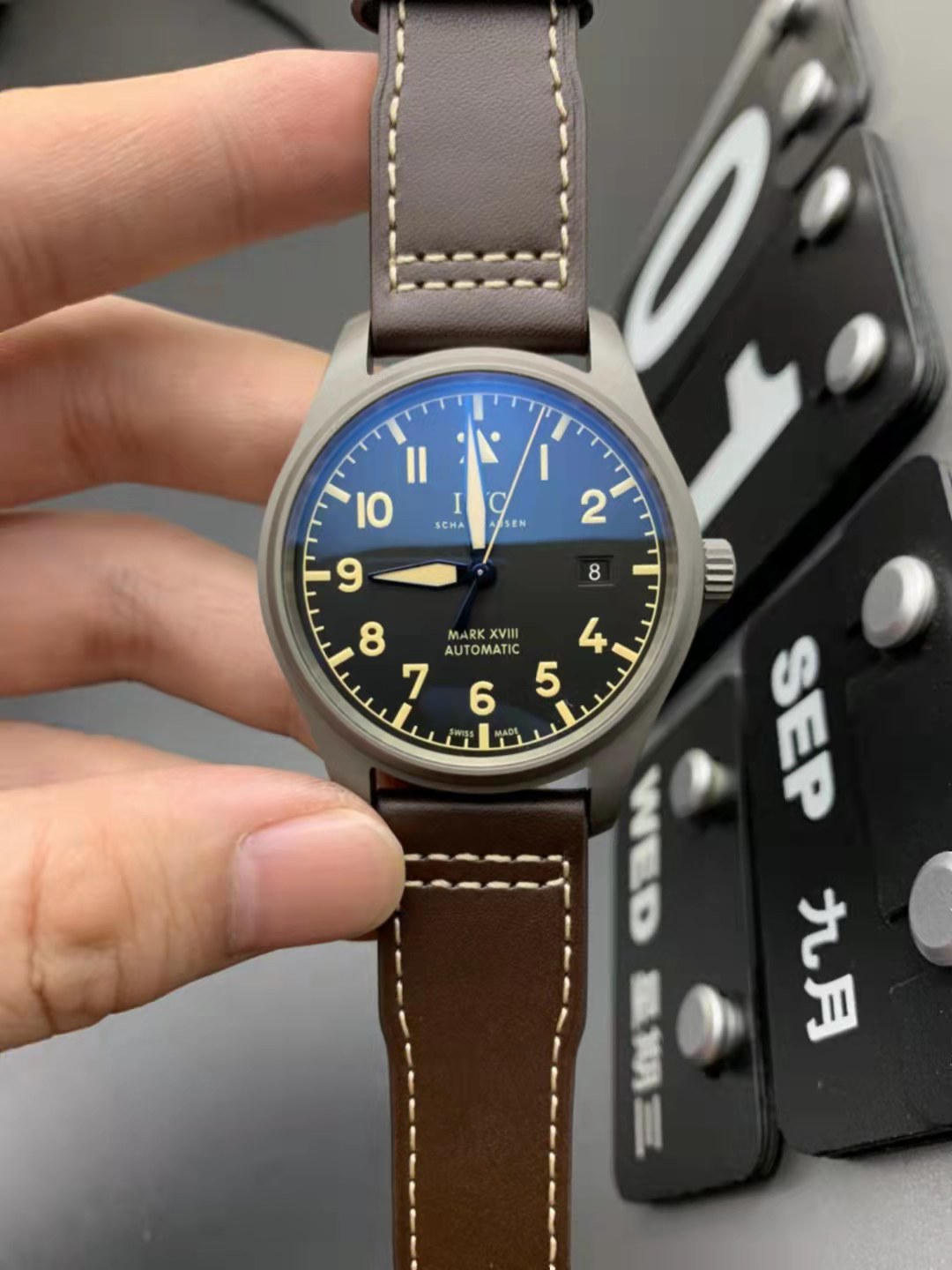
1. IWC in the Replica Industry Context
Within the replica industry, IWC has always occupied a slightly unusual position. The demand is stable, but it has never reached the explosive volume of Rolex sports models. Factories like ZF spent years dominating Portuguese, Big Pilot and Portugieser chronograph production because the finishing standards required for IWC replicas are actually higher than many newcomers realize. A simple-looking dial is often harder to execute properly than a busy dial because imperfections immediately become visible. The typography alignment, lume tone, anti-reflective crystal behavior and brushing quality all become extremely important when the watch itself relies on clean military aesthetics instead of decorative complexity.
The Mark series especially follows this philosophy. The genuine IWC Mark watches were never supposed to feel luxurious in the traditional Swiss jewelry sense. Their appeal came from aviation history, instrument readability and functional design language. Because of this, collectors usually pay closer attention to details like crystal clarity, hand proportions, dial texture and case finishing rather than obvious luxury cues. This creates a very different challenge for replica factories. If the brushing looks too shiny, it immediately feels wrong. If the dial printing is too sharp or too white, it loses the aged military atmosphere that defines these watches.
Earlier factories attempted the Mark XVIII before V7 entered the project. M+F produced one of the earlier versions around 2019, while MK Factory also released its own interpretation. Neither was terrible for the time, but both suffered from typical issues seen in mid-tier IWC replicas during that era. The dial printing tended to look slightly flat under direct lighting, the titanium texture lacked realism, and the overall watch sometimes felt more like a standard stainless steel pilot watch pretending to be titanium rather than an authentic military-inspired piece. Bracelet and strap integration also lacked the slightly rugged personality seen on genuine IWC pilot models.
“V7 approached the project differently. Instead of trying to exaggerate the watch into looking luxurious, they leaned harder into the military character. That decision changed the entire personality of the replica.”
2. Dial Aesthetics and Visual Atmosphere
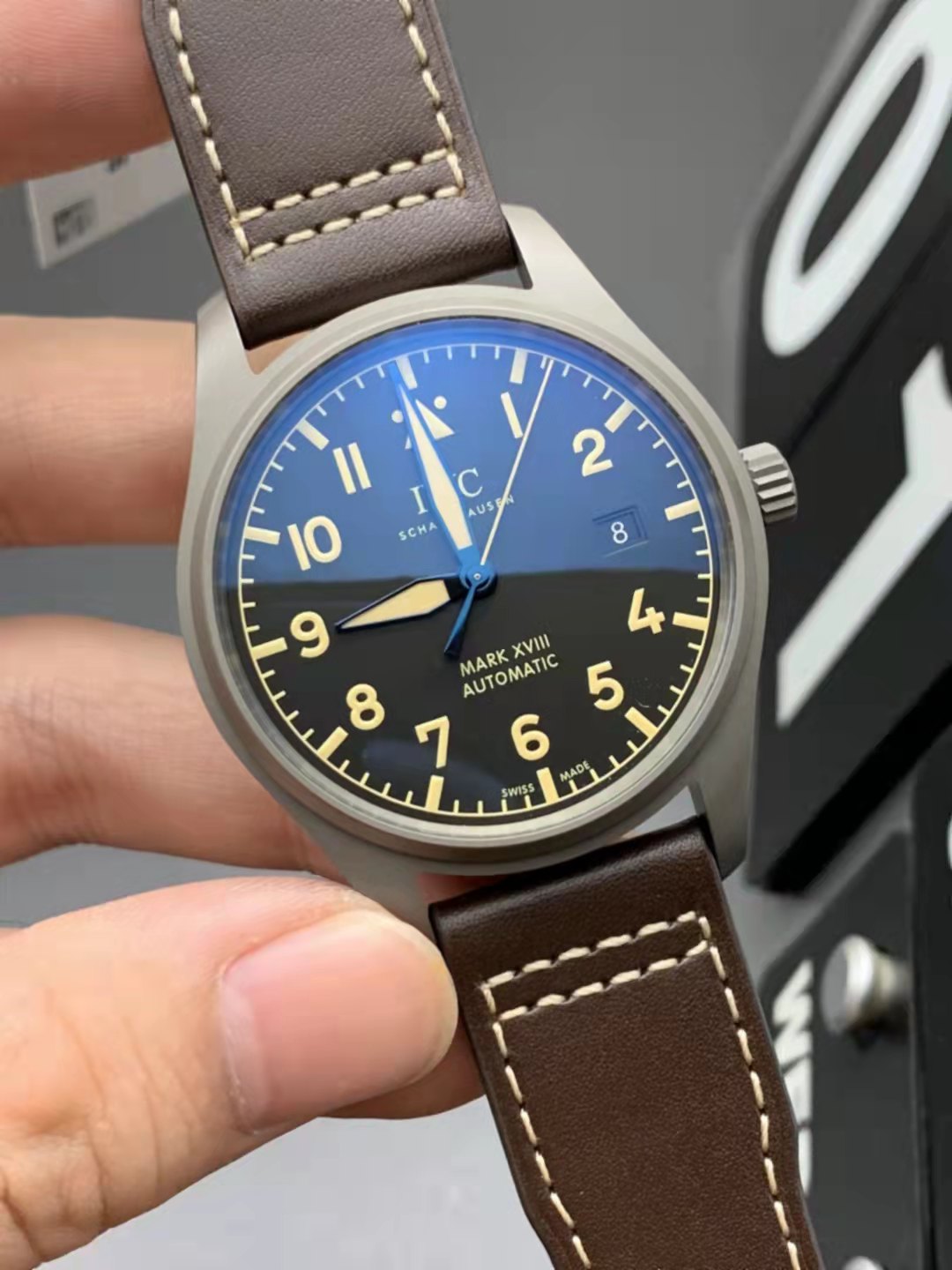
The first thing most experienced collectors notice is the dial atmosphere. On paper, the Mark XVIII dial looks extremely simple. Large Arabic numerals, triangle marker at twelve, white printing, black background and straightforward handset. But the reason many cheap replicas fail is because they misunderstand the emotional tone of military pilot watches. Genuine IWC pilot dials rarely look sterile. The printing feels slightly softened. The lume color has warmth instead of bright clinical whiteness. The crystal creates subtle depth rather than harsh reflections. V7 understood this balance surprisingly well for the period.
The lume application on this replica is intentionally slightly creamy instead of bright white. Under natural lighting, this creates a more convincing vintage military tone that matches the muted titanium case extremely well. Some newer factories actually overdo faux-vintage lume by making it orange or excessively yellow. V7 avoided that mistake. The dial still feels modern enough to resemble a contemporary IWC release while carrying the slightly aged appearance collectors usually want from a titanium field-style pilot watch.
Another important detail is the crystal behavior. IWC genuine pilot watches are known for extremely effective anti-reflective coating, often producing a near “no crystal” visual effect under certain lighting conditions. Many low-end replicas completely fail here because the crystal either reflects too much blue light or appears cloudy. V7’s implementation is not perfect compared to genuine examples, but it captures enough of that transparent dial presentation to make the watch visually convincing during normal wear.
The hand stack and hand finishing also deserve discussion. Unlike Rolex GMT replicas where incorrect hand stack immediately exposes a fake movement architecture, the Mark XVIII is mechanically simpler, which benefits replica factories significantly. Because the watch itself focuses on clean readability, the hands become visually important. V7 managed reasonably sharp hand finishing with acceptable lume consistency. Under macro photography, flaws still exist, but on wrist the proportions and balance look believable.
3. Case Finishing: The Titanium Texture Mastery
Collectors who mainly follow modern super clone projects sometimes underestimate how important case texture is for military watches. The titanium case here is actually more important than the movement itself in determining whether the watch feels authentic. Titanium reacts differently to light than stainless steel. It absorbs brightness instead of reflecting it aggressively. When factories polish titanium incorrectly, the entire watch immediately loses realism.
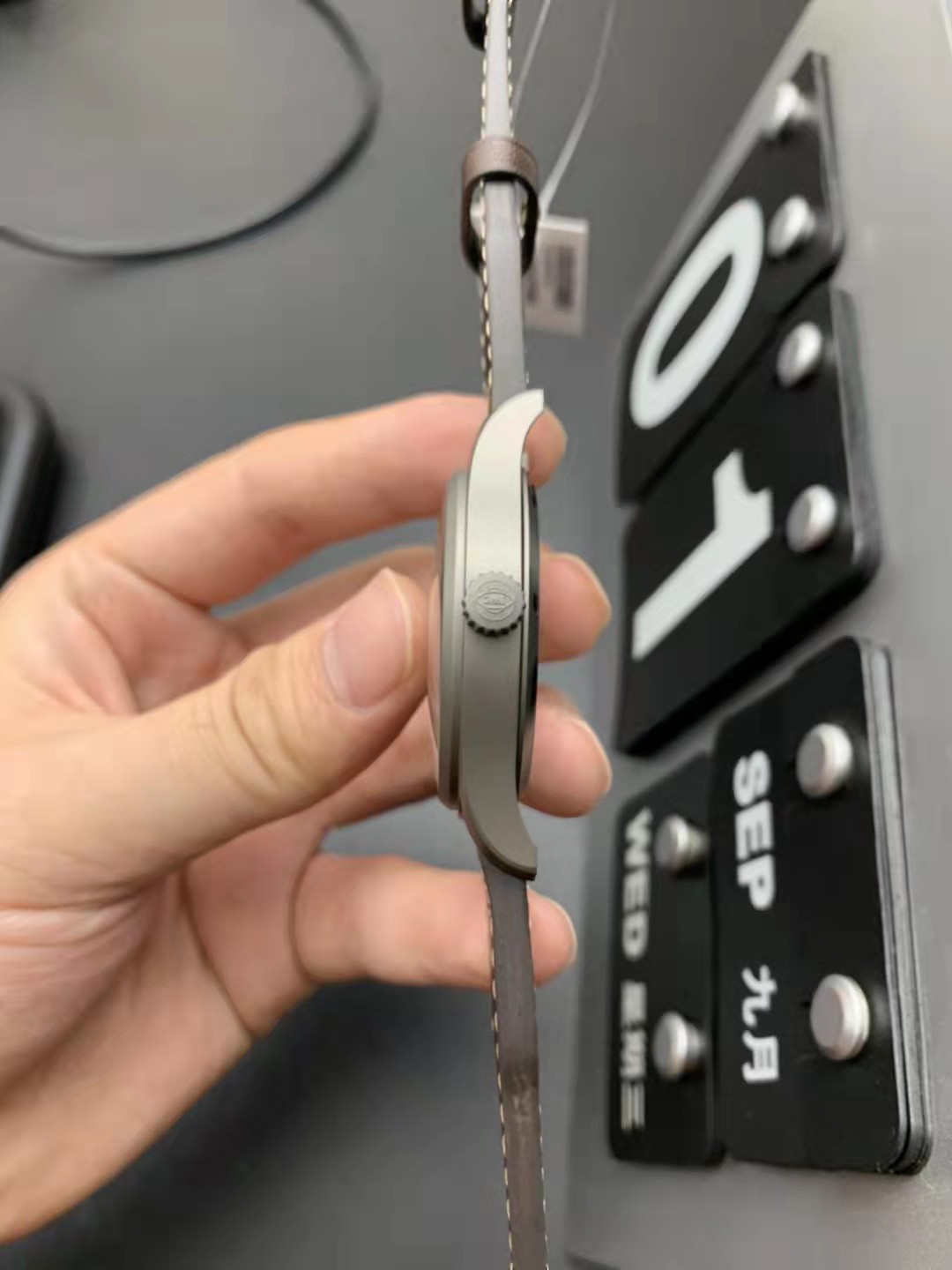
V7’s satin brushing remains one of the strongest aspects of this project. The finishing across the case surfaces feels appropriately subdued and tool-like rather than decorative. Even today, many inexpensive titanium replicas still look too bright because factories simply adapt stainless steel finishing techniques onto titanium components without adjusting texture depth or brushing direction. V7 managed to preserve the darker, softer visual behavior associated with titanium pilot watches.
The crown execution is another detail that enthusiasts tend to appreciate after extended wear rather than initial inspection. Genuine IWC pilot crowns usually have very tactile functionality because they are inspired by aviation glove usability. Some replica factories make crowns too small or overly decorative. Here, the crown feels proportionally correct and visually integrated into the military aesthetic. Its matte finishing also contributes to the understated character of the watch.
Strap pairing matters heavily on watches like this. A military pilot watch with the wrong leather texture can completely lose its atmosphere. V7 chose a brown leather strap that works particularly well with the warmer lume tone and muted titanium case. The combination avoids the overly modern tactical aesthetic seen on some aftermarket pilot straps and instead creates a more vintage aviation appearance. This matters because many collectors buying an IWC Mark replica are specifically searching for something different from glossy ceramic sports watches dominating the current replica market.
4. Movement Strategy: Reliability Over Hype
One reason the Mark XVIII replica scene never became overcrowded is because there is limited room for “spec sheet marketing.” Factories could not simply advertise larger power reserve, heavier weight or more complicated clone movement architecture the way they do with Daytona or GMT projects. The success of an IWC Mark replica depends almost entirely on atmosphere and execution quality. That naturally limits mass-market hype because these are qualities collectors usually understand only after wearing the watch for some time.
Inside the replica industry hierarchy, V7 Factory itself occupies an interesting position historically. The factory was never as dominant as VS or Clean in overall market visibility, but among certain categories they earned a strong reputation. Older collectors still remember V7’s earlier Ingenieur and Portuguese projects very positively because the factory often prioritized overall wearability instead of exaggerated marketing upgrades. Their watches generally aimed to feel coherent rather than flashy.
This philosophy appears clearly in the Mark XVIII Titanium project. There is no attempt to oversell impossible “1:1 perfection.” Instead, the watch focuses on delivering the correct wearing experience. Ironically, this often ages better than heavily hyped releases whose marketing claims collapse once collectors compare them closely against genuine watches.
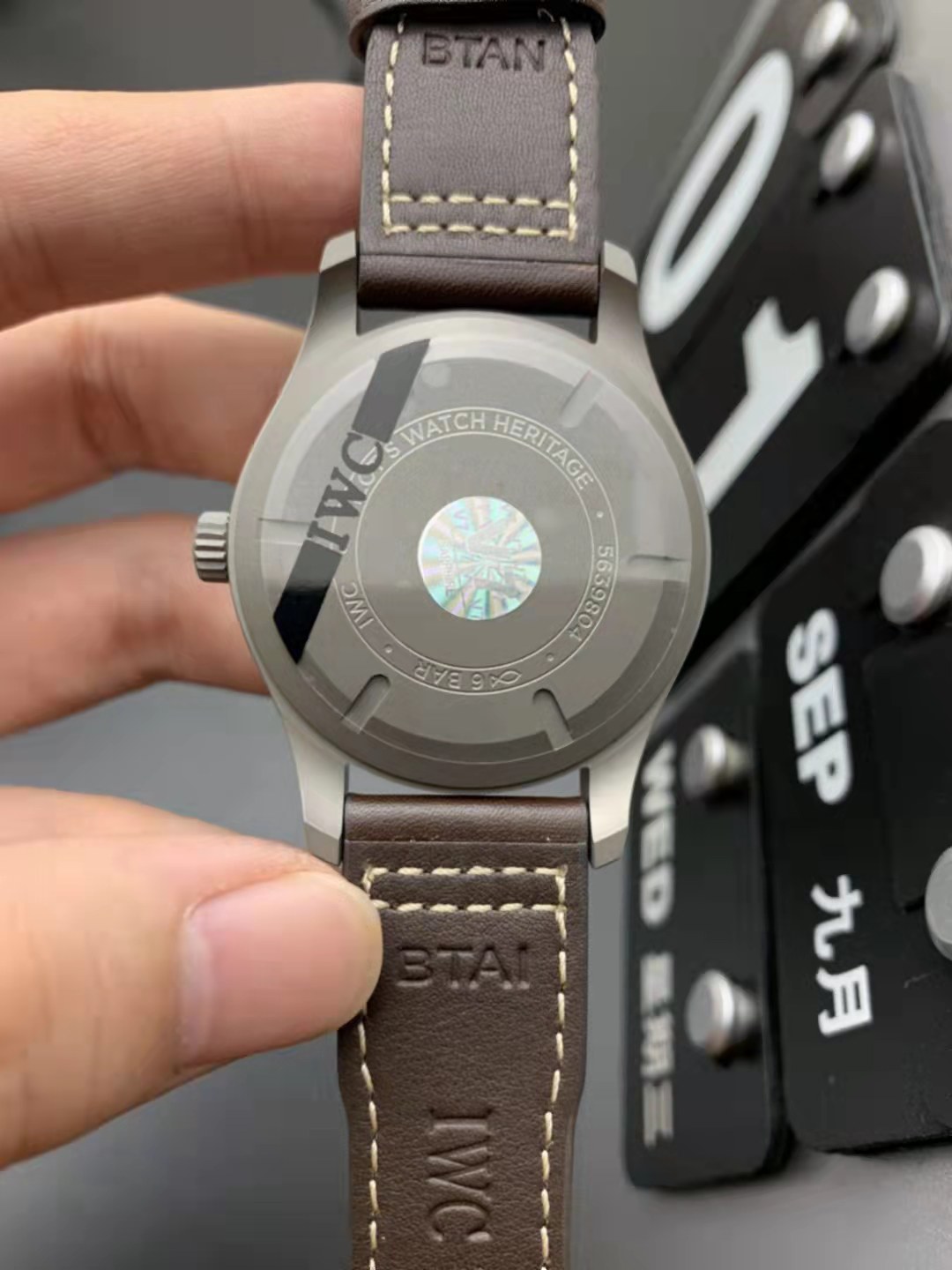
The engraved case back continues this restrained approach. Genuine IWC pilot case backs are deeply tied to aviation culture, and collectors usually pay close attention to engraving sharpness and tonal consistency. Cheap replicas often produce laser engravings that appear too shallow or too bright. V7’s engraving depth and finishing are respectable for the generation. More importantly, the overall visual tone matches the rest of the watch instead of appearing disconnected.
From a movement perspective, V7 offering both clone 2892 and genuine Swiss ETA 2892 options was actually a very smart decision. The ETA 2892 architecture has long been respected for thinness, reliability and smooth winding behavior. Many experienced collectors still prefer simple, stable movement platforms over increasingly ambitious clone calibers attempting to replicate highly complicated Swiss mechanisms.
Within the replica industry, movement discussion has changed dramatically over the last five years. Earlier generations of buyers mainly cared about reliability and ease of servicing. Then the market entered the “super clone era,” where factories started aggressively pursuing visual movement accuracy through cloned Rolex 3235, 4130, 4131 and Patek architectures. While technically impressive, this shift also created new risks involving servicing difficulty, parts compatibility and long-term durability.
The Mark XVIII avoids many of those complications precisely because it remains mechanically straightforward. A properly regulated 2892-based movement is more than enough for a watch built around military simplicity. In fact, many collectors eventually return to simpler watches after spending years chasing increasingly complicated super clones. There is something refreshing about a clean three-hand pilot watch that focuses entirely on proportion, comfort and legibility.
Another reason this V7 project aged relatively well is because the genuine IWC Mark XVIII itself has timeless proportions. Unlike trend-driven oversized watches from the early 2000s, the Mark XVIII maintains balanced dimensions suitable for everyday wear. Replica factories sometimes struggle when genuine designs depend heavily on luxury finishing or precious metal texture, but functional pilot watches translate more naturally into the replica world because their identity is built around utility rather than jewelry-level detailing.
5. V7 Factory IWC Mark XVIII: Quick Summary
| Feature | Pros (What V7 Got Right) | Cons (Remaining Flaws) |
|---|---|---|
| Case Material | Subdued titanium texture; excellent tool-like satin brushing. | Weight distribution differs slightly from genuine. |
| Dial & Lume | Warm, creamy lume tone; authentic military atmosphere. | Dial print under extreme macro lacks perfect sharpness. |
| Crystal | Good anti-reflective behavior; highly transparent. | Not fully equivalent to the genuine “no crystal” effect. |
| Movement | Stable Clone 2892 or genuine Swiss ETA 2892 options. | Lacks visual decoration of high-end custom clones (hidden by caseback). |
| Strap | Great color pairing that matches the vintage aesthetic. | Leather softness and edge finishing feel mid-tier. |
6. The Verdict: Why Emotional Authenticity Trumps Micro-Accuracy
That said, experienced collectors can still identify flaws if they examine the watch closely. The dial print under extreme macro magnification is not fully equivalent to genuine IWC sharpness. The lume texture can appear slightly less refined. The leather strap quality, while visually attractive, still falls short of high-end genuine pilot straps in softness and edge finishing. The titanium weight distribution also differs slightly from genuine examples if directly compared side-by-side.
But these observations miss the larger point of why the replica succeeds. This is not a watch pretending to be ultra-luxury jewelry. It is a military-inspired tool watch replica that successfully reproduces the mood and wearing experience of the original. That distinction matters.
Modern replica culture increasingly revolves around direct comparison photography and microscopic accuracy discussions. Collectors spend hours discussing rehaut engraving depth, hand pinion polishing or balance bridge geometry. Those details absolutely matter on certain projects. But watches like the Mark XVIII remind people that emotional authenticity is equally important. Does the watch feel believable on wrist? Does the visual language remain coherent? Does the finishing support the design philosophy of the original watch?
In those areas, the V7 Factory Mark XVIII Titanium performs surprisingly well even years after release.
The broader IWC replica market also deserves context here. Compared to Rolex or Audemars Piguet replicas, IWC replicas tend to attract slightly older collectors or buyers seeking lower-profile daily wear. An all-black ceramic Daytona or diamond-set Royal Oak immediately attracts attention. A titanium Mark XVIII generally does not. That subtlety becomes increasingly appealing to collectors who no longer want obvious flex pieces.
There is also the question of factory evolution. During the peak years of ZF’s IWC dominance, many collectors expected continuous upgrades similar to Rolex factories releasing V2, V3 and V4 batches every few months. But the IWC market never fully adopted that cycle. Many successful IWC replicas simply remained stable for years because there was less pressure for constant cosmetic revisions. The Mark XVIII Titanium exists within that older philosophy of replica production, where a good version simply stayed on the market without endless marketing campaigns.
Some collectors actually prefer this older factory culture. Today’s replica environment can feel exhausting, with every new batch immediately declared obsolete after another small update. Earlier projects like the V7 Mark XVIII were appreciated more organically. Collectors wore them for years instead of constantly upgrading to the next incremental revision.
This also explains why pilot watch replicas continue maintaining a loyal niche audience despite the overwhelming popularity of Rolex sports models. Military watches communicate taste differently. They feel more personal and less performative. A titanium IWC pilot replica paired with a worn leather strap tells a completely different story from a fully polished ceramic sports watch.
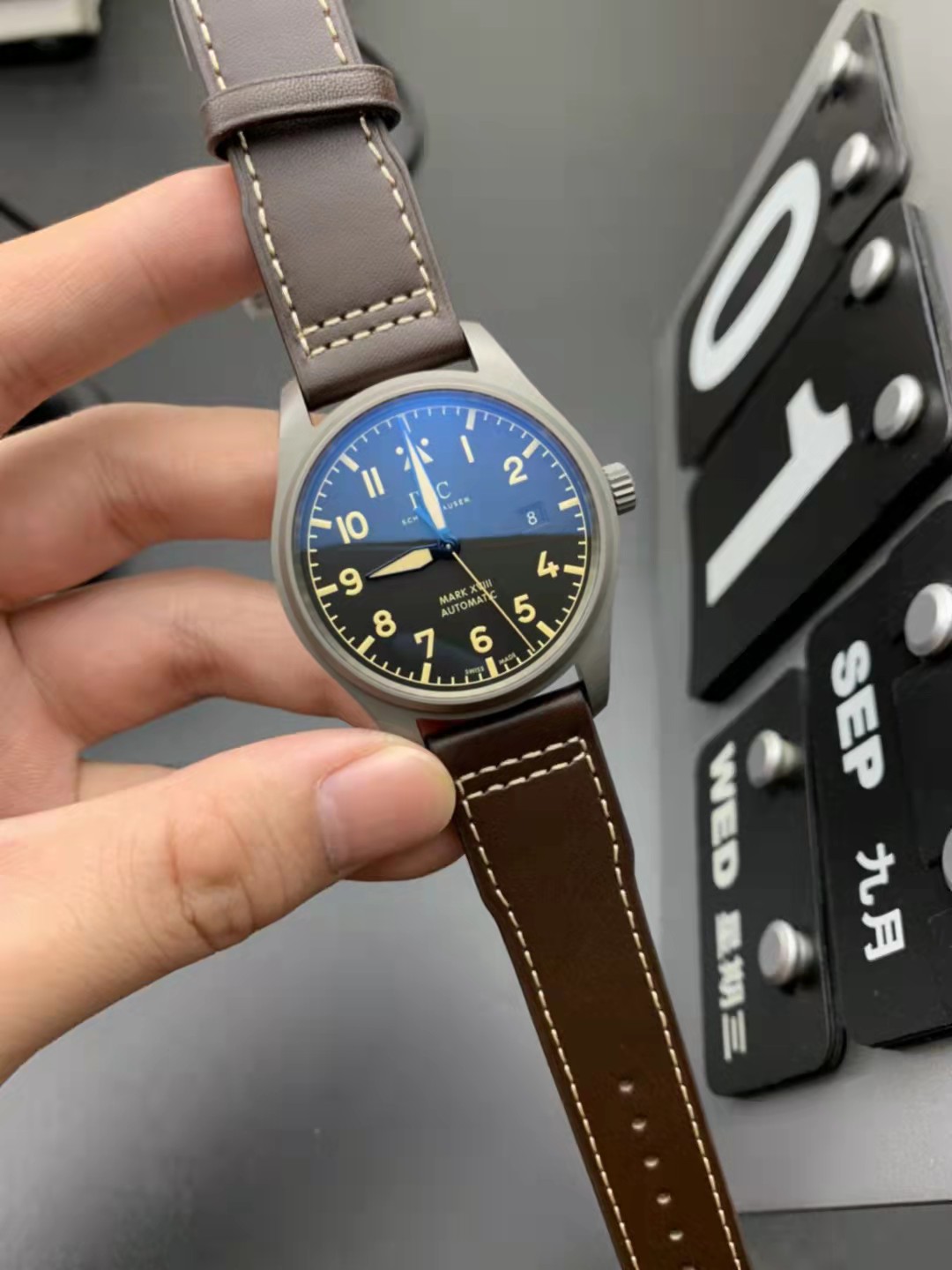
Viewed today, the V7 Factory IWC Mark XVIII Titanium almost feels like a snapshot from a different era of the replica industry. Before every discussion revolved around clone movement architecture and CNC case tolerances, factories still produced watches centered around atmosphere and wearability. This project represents that philosophy unusually well.
It may not generate the same excitement as a new-generation Clean GMT or VS Daytona release, but that was never the point. The appeal of this watch comes from its restraint. The muted titanium finishing, warm lume tone, military dial layout and simple 2892 architecture combine into something that feels coherent instead of over-engineered.
For collectors who appreciate understated military watches, the V7 Mark XVIII Titanium remains one of those rare replica projects that actually becomes more interesting with time. Not because it achieved absolute perfection, but because it understood the original watch well enough to preserve its personality.
