
How Is a Top-Tier Replica Watch Made? Inside the Complete Step-by-Step Process of Luxury Watch Cloning
In the shadows of the global watch industry lies a highly industrialized, multi-million dollar sector: the world of high-end replica watch manufacturing. While controversial and operating in a legal gray zone, some of these secretive “super clone” factories now produce timepieces so close to the originals that they routinely fool seasoned watch collectors, grey-market dealers, and even authorized service technicians at first glance.
What most people don’t realize is just how much engineering, capital, and skilled labor goes into making a single high-grade replica. This isn’t a backroom operation with glue guns and cheap parts. At the top end of the market, these are modern, well-equipped facilities running advanced CNC machines worth hundreds of thousands of dollars, staffed by watchmakers who spent years inside the legitimate Swiss OEM supply chain.
Let’s take a deep dive into this mysterious world and see exactly how these top-tier replica watches are created—from the initial retail sample to the final product on your wrist.
Where Are the Major Replica Watch Factories Located?
Contrary to popular belief, the production of high-end replica watches is not a scattered cottage industry. It is concentrated in a few strategic regions with strong industrial bases, advanced micro-machining infrastructure, and localized supply chains.
| Region | Characteristics | Representative Factories |
|---|---|---|
| Guangdong, China (Guangzhou, Shenzhen) | The absolute epicentre. Full institutional supply chain support from heavy CNC machining to movement assembly. | Clean (CF), VSF, ZF, Noob (Historical), JF, AR, BP, GF, APSF |
| Hong Kong | Acts primarily as a global logistics transit, financial clearing, and sales hub, handling international distribution. | N/A (mostly master agents and trusted dealers) |
| Italy | Home to skilled artisan workshops, historically famous for high-grade Franck Muller and Panerai case modifications. | TMF (reportedly active in low-volume custom builds) |
| Japan | Known for meticulous detail accuracy, vintage modification kits, and small-scale custom production. | RXW (historically rumored to focus on high-end Patek and vintage Rolex) |
| Vietnam, Thailand, Malaysia | Small workshops, frequently serving as secondary assembly points or for shipping preparation to evade customs. | – (Local independent modders) |
Note: Shenzhen’s Shuibei and Guangzhou’s Zhanxi area are often called the “Silicon Valley of replica watches.” Component factories, dial printers, and movement modders operate within a tight industrial ecosystem. Walk through certain streets in these districts and you’ll find raw case blanks stacked next to CNC machines, movement specialists working under microscopes, and QC staff comparing finished pieces against genuine references under bright fluorescent lights.
This hyper-local concentration creates an incredibly fast supply chain feedback loop. Dial makers, case finishers, and packaging producers are all within a short drive of each other. Lead times shrink, quality improves, and cost per unit drops—allowing these factories to outpace earlier generations of replica producers by a wide margin. If you’re buying from any serious dealer, chances are your watch passed through this network at some point.
Step 1: Sampling and Digital Reverse-Engineering
Every serious replica starts not with shortcuts, but with the real thing. This first phase determines whether the finished product will pass as believable or fall apart under basic scrutiny.
Acquiring an Authentic Sample
Factories purchase original, brand-new retail watches—especially bestsellers like the Rolex Submariner 126610LN, Cosmograph Daytona 116500, Patek Philippe Nautilus 5711, or Audemars Piguet Royal Oak—to use as precise reference templates. A single original watch can cost anywhere from $10k to $50k+, but factories consider this a standard R&D expense. Multiple samples are often purchased at different production dates to track subtle design revisions the genuine brands make between batches.
Full Destructive Disassembly
Once acquired, expert watchmakers completely strip down the authentic timepiece. Every single component—case, bezel, dial, hands, crown, crystal, spring bar, gasket, and movement gear—is isolated to analyze its exact metallurgical composition, weight, dimensions, and functional design under high magnification. The goal is to understand how much play exists in the bracelet links, how the crown feels when winding, and at what exact point the date jumps.
3D Scanning & CAD Modeling
Using industrial-grade blue-light laser scanners, engineers capture the geometry of every part with micron-level precision. Using CAD software (e.g., SolidWorks), they recreate each component digitally to tolerances as fine as 0.01mm. This CAD library becomes the master reference for toolpaths for CNC machines, and it gets updated whenever the factory identifies a flaw or when the authentic brand releases a revised model.
Step 2: Heavy Machinery, Mold Creation & CNC Production
Case, Bezel & Bracelet Finishing
Top-tier factories do not use cheap pot metals. Cases and bracelets are produced using 5-axis CNC milling machines (often high-end imported tooling worth over $100k) operating on genuine 316L or 904L stainless steel—the exact high-chromium alloy Rolex uses. 904L is harder and noticeably more difficult to machine, which is why lower-tier factories stick with 316L. Top-tier operations have invested in the proper tooling, and the surface finish difference is highly visible in how the metal reflects light after multi-stage diamond-paste polishing and industrial brushing.
Bracelet finishing has improved dramatically. Current productions use incredibly tight tolerances between links, eliminating the loose, floppy feel common in older generation replicas.
Dial, Hands & Applied Indices
- Logos, fonts, and indices are applied with microscopic accuracy using high-precision pad printing machines that often cost $20k+ each to eliminate bleeding.
- Hour markers and hands are diamond-cut, rhodium-plated to prevent oxidation, and filled with genuine Swiss Super-LumiNova (GL C3 or BGW9) from the same suppliers legit brands use, ensuring an identical nocturnal glow profile.
- Hand pinions are capped and polished, eliminating the “hollow look” center hole that instantly gives away low-end fakes. Hand lengths and curvature match original specifications precisely.
Micro-Engraving & Rehaut Alignment
Laser engravings on casebacks, crowns, clasps, and lugs are duplicated with 1:1 fidelity, capturing exact font depth, spacing, and double-line serifs. The inner rehaut engraving on modern Rolex models requires advanced laser equipment and a willingness to scrap pieces that don’t hit dead-center alignment, which adds cost but makes visual detection near-impossible without a loupe.
Step 3: The Heart of the Watch – The Movement Architecture
A watch is only as convincing as its sweep, and top factories understand that a replica will fail entirely if the movement is unreliable or looks completely wrong under a sapphire display caseback.
Option A: Modified Chinese Movements
Standard, reliable workhorse movements from Seagull (like the ST2130) or Shanghai factories are fitted with decorative plates (bridges) to visually mimic Swiss layouts. These are reliable and functional, but they lack the genuine finishing quality when inspected closely.
Option B: Genuine Swiss/Asian ETA Workhorses
True Swiss ETA 2824-2, 2836, or their high-grade Asian counterparts are utilized for standard three-hand models. These offer consistent regulation, easy servicing, and widely available spare parts. However, because the ETA architecture doesn’t perfectly replicate the visual layout of the target movement, the difference is apparent through an open caseback.
Option C: Bespoke “Super Clone” Standalone Movements
This is where elite factories like Clean, VSF, and ZF dominate. They fund exclusive production lines with movement giants like Dandong to build ground-up clone movements (such as the Dandong 4130, VS3235, or Dandong 3285). These replicate not just the aesthetics, but the exact mechanical functionality, gear trains, instant date-flip at midnight, twin-barrel power reserves, and balance wheel positions of the Swiss originals. VSF’s VS3135 or Clean’s 3235 movements reproduce the internal layouts so closely that they can even accept genuine Rolex parts during servicing.
Step 4: Clean-Room Hand Assembly & Multi-Tier QC
Manual Bench Assembly
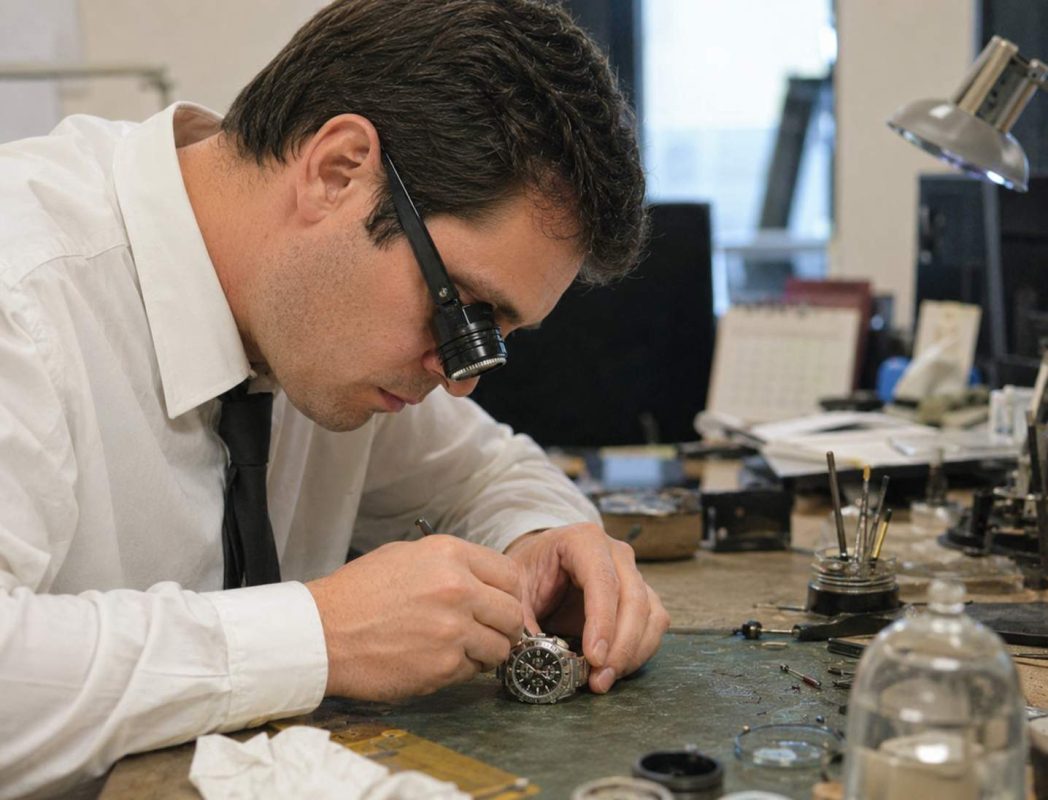
Despite heavy industrial automation in case cutting, final assembly remains a highly skilled human art. Mounting delicate hands without scratching the dial, aligning the date wheel overlay, and pressing the sapphire crystal with correct gasket pressure are done by hand under 10x magnification loops on dust-free benches. A slight misalignment at this stage produces a crown that doesn’t seat flush or a misaligned seconds hand that throws off the visual balance.
Multi-Stage Technical QC
- Chronometric Regulation: Every watch is placed on a digital timegrapher and regulated to within an acceptable ±5 to ±10 seconds per day, while checking beat error and amplitude to ensure long-term movement health.
- Waterproof Testing: Cases undergo dry air-pressure testing chambers and wet vacuum tests up to 3 to 10 ATM (30m – 100m) to ensure seals are secure for daily wear. Some buyers independently test these and find them completely water-tight.
- Macro Visual Checks: High-resolution alignment checks ensure bezel insert markers align perfectly with dial indices, avoiding the notorious “misaligned 12 o’clock” issue. Top factories don’t ship QC failures because a single viral comparison post on collector forums can ruin their reputation.
Step 5: Packaging, Cross-Border Logistics & Distribution
To complete the luxury illusion, separate independent operations produce cloned serialized warranty cards, RFID-embedded tags, green Rolex leather boxes, and Patek presentation manuals. Because these goods cannot be sold openly, they bypass traditional retail via a highly secure, decentralized network:
Factory Assembly Line → Master Regional Agent → Trusted Dealers (TDs) → International End-User
Most transactions occur on private encrypted networks, specialized watch forums (like RWI and RepTime), Telegram channels, and hidden custom-built portals. Trusted Dealers utilize discrete triangular shipping routes to clear global customs safely, with a typical wait time from order to delivery of 1–3 weeks depending on customs inspection risks.
Why Are These Factories So Successful at Deep Cloning?
| Critical Success Factor | Industrial & Economic Explanation |
|---|---|
| Ex-OEM Tooling Talent | Many master technicians and CNC programmers were formerly employed by legitimate Swiss/Japanese joint-venture component manufacturers in Mainland China, bringing institutional knowledge directly into the replica supply chain. |
| Massive Capital Reinvestment | Top syndicates reinvest millions into securing authentic piece references, acquiring Swiss-made CNC equipment, and securing exclusive movement manufacturing contracts. |
| Rapid Horizon Iteration | Unlike traditional brands on 5-year cycles, these factories treat collector feedback as free R&D. They monitor online communities and release rolling updates (V1, V2, V3, V4…) within months to fix any community-reported flaws. |
| Hyper-Localized Ecosystem | The unprecedented proximity of specialized sub-contractors (crystals, bracelets, ceramic bezels) allows for hyper-efficient sourcing, zero friction logistics, and fast quality control loops. |
| Material Parity | Top operations use the exact raw material grades as their targets—904L steel, sapphire crystal, Swiss lume—making material-based detection increasingly difficult without laboratory analysis. |
How Do Top Replica Factories Compare to Mid-Tier and Budget Producers?
The gap between a top-tier factory output and a budget replica can be wider than the gap between a good replica and the genuine article. Here is a practical breakdown of where those differences show up:
| Feature | Budget Replica | Mid-Tier Replica | Top-Tier (Super Clone) |
|---|---|---|---|
| Case Steel Grade | 316L or cheap base metals | Standard 316L Stainless Steel | Genuine 904L Stainless Steel (for Rolex targets) |
| Movement Type | Generic low-end Chinese automatic | Seagull or decorated ETA base | Bespoke ground-up clone caliber (Dandong/VS) |
| Dial & Printing | Single-layer, low-resolution printing | Multi-layer, decent visual accuracy | Multi-layer pad printing, exact alignment, matched to gen |
| Luminous Material | Generic phosphorescent paint (weak glow) | Standard Asian-made lume | Genuine Swiss Super-LumiNova (C3 / BGW9) |
| Visual Accuracy | Low (Easily spotted from 1 meter away) | Medium (Fails macro inspection or loupe check) | High (Requires caseback removal or microscopic inspection) |
Navigating the Super Clone Market: What Collectors Must Know
Though their legal status remains firmly illicit, the sheer engineering capabilities of modern super-clone factories have forced a paradigm shift in the watch world. They are no longer producing the cheap, brassy fakes found on street corners in the 1990s; they have evolved into high-precision, shadow manufacturing powerhouses.
In today’s market, these high-end replicas are so structurally accurate that without opening the caseback and examining the escapement under a microscope, they can easily deceive retail store associates, experienced trade-in buyers, and general collectors. There are documented cases of replica watches being sold as genuine on secondhand markets, which tells you everything about the quality ceiling these factories have reached.
As precision manufacturing technology becomes democratized and global demand for unattainable luxury timepieces continues to skyrocket, the replica world is no longer just making cheap imitations—it has established a sophisticated, parallel industry that mirrors the craftsmanship, engineering, and obsessive detail of the genuine horological world.
