
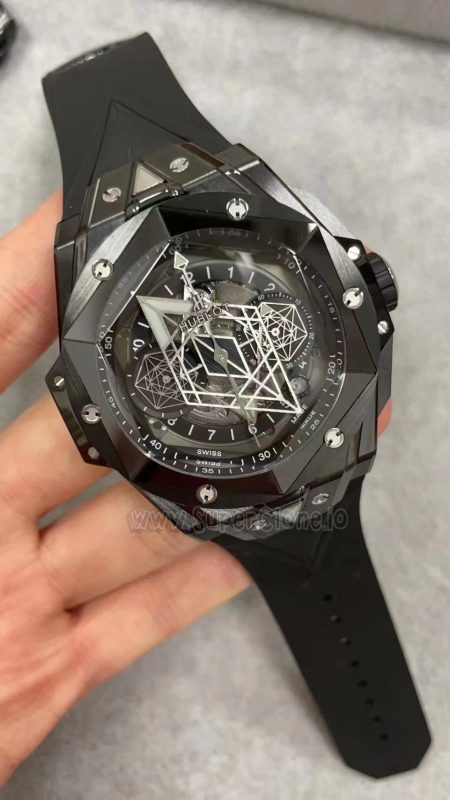
Hublot Sang Bleu in Ceramic: Why ZF’s Version Changed the Conversation Around Big Bang Replicas
For years, most discussions around Hublot replicas focused on familiar names inside the Big Bang collection. Unico chronographs, classic steel Big Bang models, and carbon fiber editions usually received the most attention from collectors and factories alike. The Sang Bleu line was different. It occupied a more unusual position in the Hublot catalog because the design language itself was difficult to reproduce correctly. Unlike traditional sports watches that rely on symmetry and predictable case architecture, the Sang Bleu depends heavily on geometry, depth, angular transitions, and visual balance. Replicating those characteristics convincingly is far more difficult than simply copying a dial layout or engraving a logo onto a movement rotor.
The Unique Challenge of Replicating Hublot Sang Bleu Geometry
That difficulty explains why earlier Sang Bleu replicas from smaller factories never fully established a strong reputation among experienced buyers. Some looked acceptable in photographs but lacked precision around the bezel geometry. Others used weak dial printing, inconsistent ceramic finishing, or poorly decorated movements hidden behind sapphire casebacks. The overall shape of the watch is so aggressive and architectural that even small inaccuracies become immediately visible once the watch is on the wrist.
ZF entering this segment therefore became more significant than many people expected at the time. Before releasing the Sang Bleu, ZF had already built a strong reputation in several categories, especially with sports watches that required cleaner finishing standards and better movement presentation. Their previous Hublot projects had shown that the factory was gradually moving deeper into the modern Big Bang category rather than focusing only on safer mainstream models. When the ceramic Sang Bleu appeared, many collectors interpreted it as a signal that ZF intended to compete more seriously in areas previously dominated by factories such as V6, HBF, or WWF.
ZF’s Market Strategy: A Focus on Monochrome Ceramic Execution
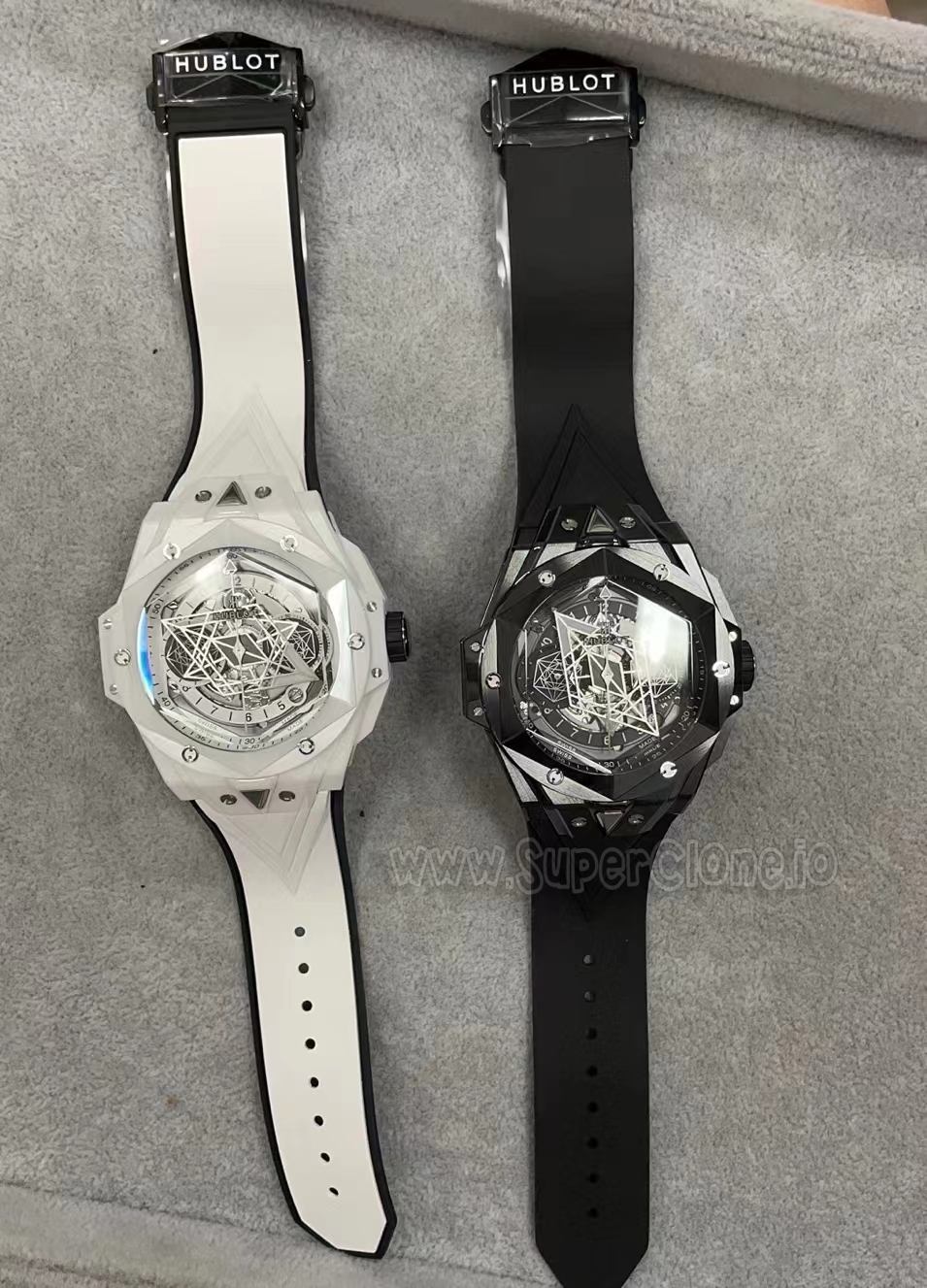
Interestingly, ZF did not begin with a wide lineup. Instead of flooding the market with multiple references and color combinations, they focused only on two ceramic versions: black ceramic and white ceramic. That decision probably helped them maintain better production consistency during the early release period. Ceramic watches are notoriously difficult to manufacture correctly, especially when the case structure contains multiple sharp surfaces and angular transitions like the Sang Bleu.
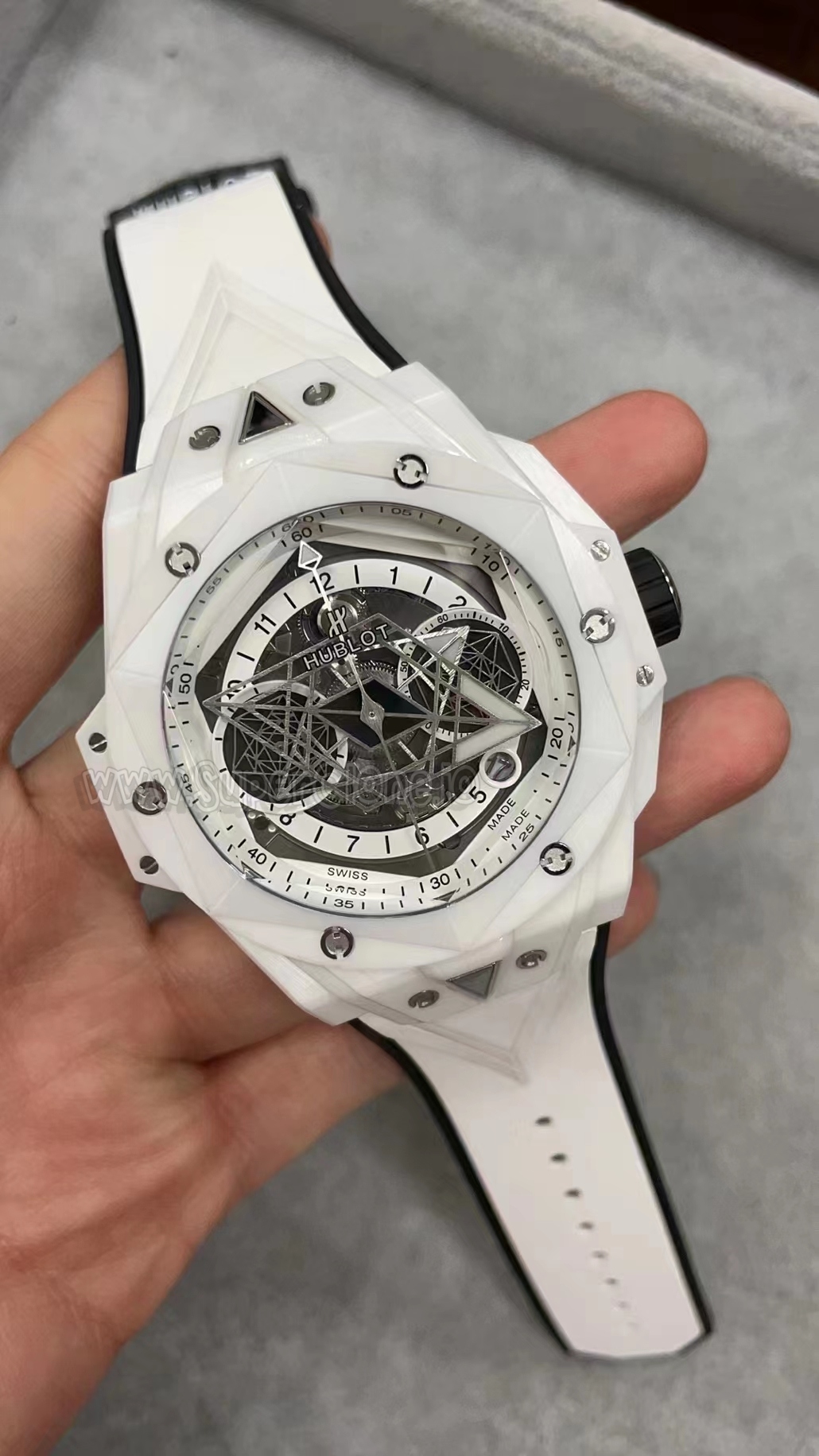
What immediately separates the Sang Bleu from ordinary Big Bang models is the complete transformation of the case architecture. Traditional Hublot Big Bang watches still retain many recognizable sports chronograph proportions. The Sang Bleu abandons most of that familiarity. The bezel shape becomes more aggressive, the edges sharper, and the entire watch appears almost sculptural rather than industrial. Some collectors compare it to modern architecture, while others describe it as wearable geometric art.
Design Philosophy: Unpacking Maxime Plescia-Büchi’s Influence
The original Sang Bleu collaboration itself already carried a strong visual identity because of Maxime Plescia-Büchi’s tattoo-inspired geometric concepts. That influence can still be seen everywhere on the watch. The lines are not decorative additions placed on top of a normal sports watch. Instead, the entire design language is built around polygons, intersecting angles, layered symmetry, and depth transitions. Because of this, a replica factory cannot rely solely on correct dimensions. The watch either captures the visual rhythm of the design correctly, or it immediately feels wrong.
Material Execution and the Realities of Premium Ceramic Finishing
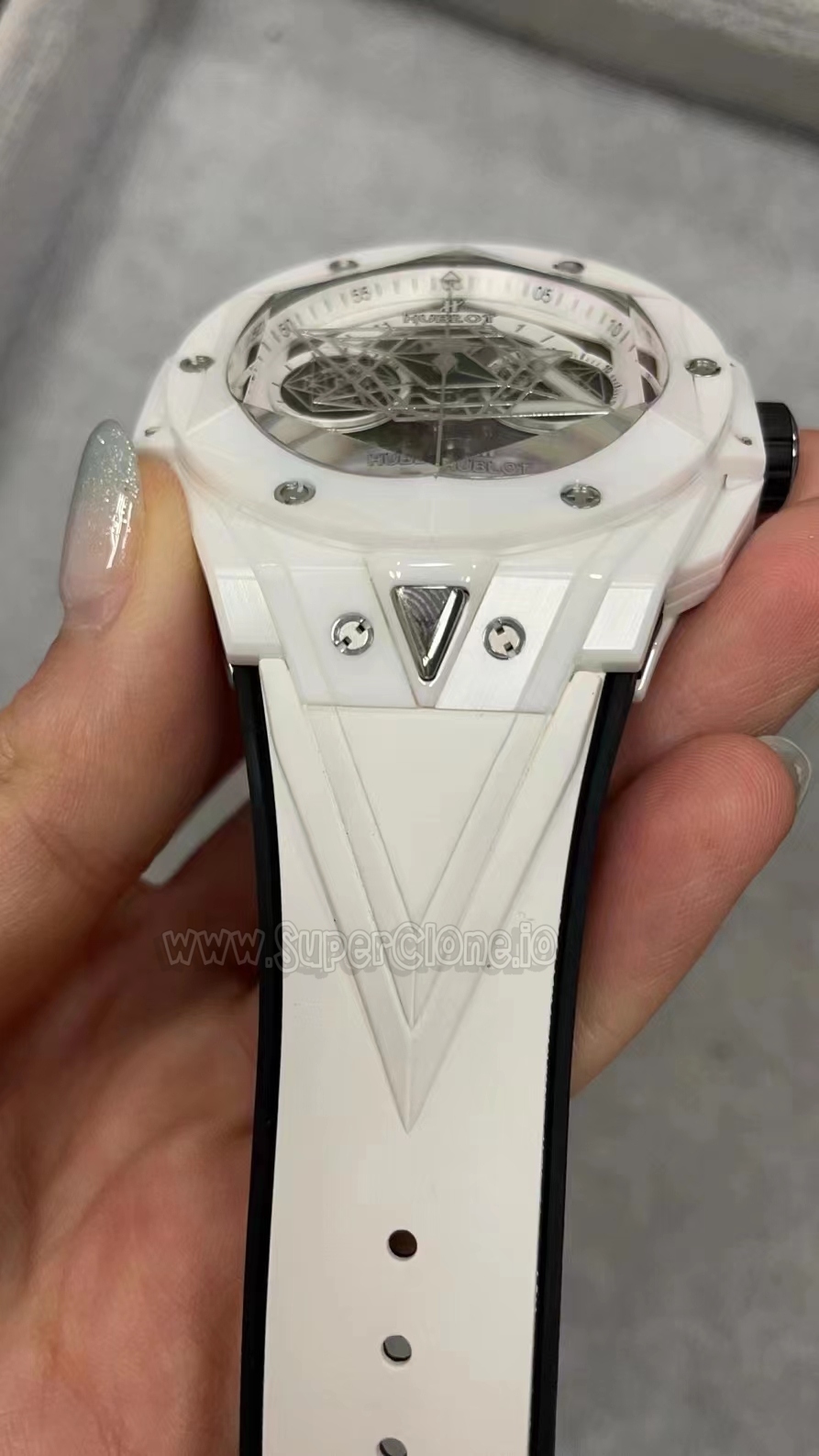
ZF’s ceramic execution was one of the reasons these models attracted attention so quickly after release. Both versions use real ceramic material for the case and bezel construction. Ceramic has become increasingly important in modern high-end sports watches because of its resistance to scratches and its distinctive surface texture. However, ceramic finishing is also unforgiving. Uneven brushing, poorly polished edges, or inconsistent coloring become very obvious under direct light.
On the white ceramic version especially, the finishing quality becomes easier to judge because bright ceramic surfaces reveal imperfections more aggressively than black ceramic. The transitions between polished and brushed surfaces appear relatively clean on the ZF model, and the angular bezel structure maintains consistent spacing around the visible screws. Earlier Sang Bleu replicas from lower-tier factories sometimes struggled with bezel alignment, especially around the geometric cut lines near the corners of the case.
Case Dimensions, Wearability, and Layered Construction
The dimensions remain faithful to the modern oversized Hublot aesthetic. The case measures approximately 45mm in diameter with a thickness around 14mm. On paper, those numbers sound large, but the actual wearing experience depends heavily on wrist shape because the angular lugs distribute the visual weight differently from a traditional round sports watch. Unlike many oversized chronographs that simply feel bulky, the Sang Bleu creates more of an architectural wrist presence.
One of the more interesting aspects of the case design is how ZF preserved the layered “sandwich” structure commonly associated with Hublot. Even though the Sang Bleu moves away from traditional Big Bang styling, the watch still uses multiple material layers including ceramic, stainless steel components, and rubber inserts. This layered construction reflects Hublot’s long-running “Art of Fusion” design philosophy, where contrasting materials and textures become part of the identity rather than hidden construction elements.
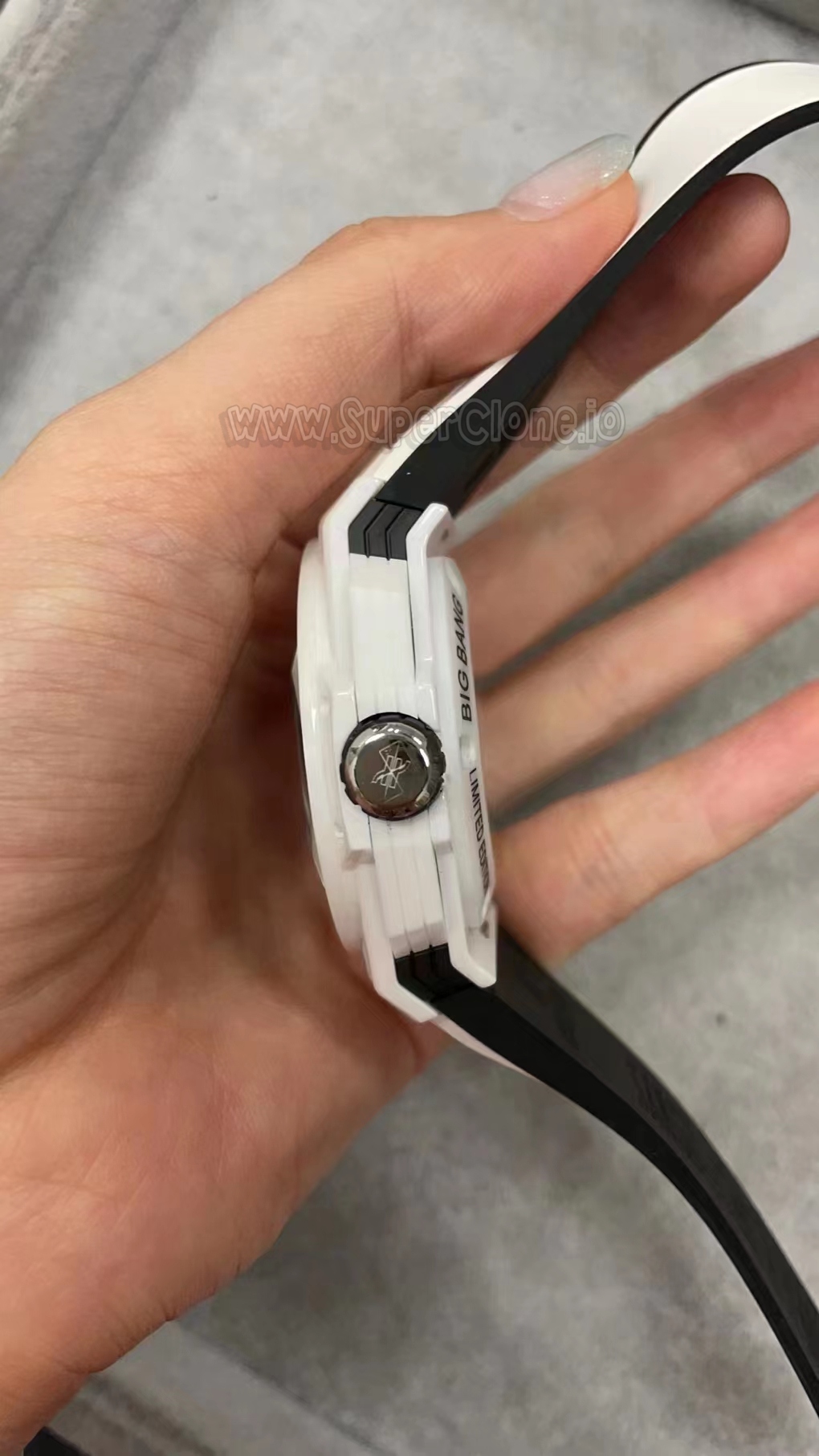
The crown area deserves more attention than many collectors initially give it. On simpler replica watches, crown finishing often becomes an afterthought because buyers focus mainly on the dial or movement. With the Sang Bleu, the crown contributes heavily to the visual cohesion of the entire watch. ZF paid attention to the engraved logo design and maintained the sharper geometric styling seen throughout the rest of the case. The crown guards, pushers, and surrounding surfaces all continue the angular design language instead of introducing softer curves that would break the aesthetic continuity.
Dial Architecture: Polygonal Layering and Visual Flow
Another reason the Sang Bleu stands apart from ordinary Hublot chronographs is the dial construction. The dial is not simply decorative. It acts almost like an extension of the case geometry. Many watches use a round dial within a round bezel and then rely on subdials or markers for visual interest. The Sang Bleu instead builds the entire dial around polygonal layering and intersecting geometric forms.
Under the sapphire crystal, the visible structure avoids conventional symmetry. The hour display is integrated into a central circular layout surrounded by angular framing elements. The small seconds display positioned around 9 o’clock becomes one of the first moving elements the eye notices because it introduces constant motion inside an otherwise highly structured design. The chronograph minute counter at 3 o’clock balances the dial visually without disrupting the geometric theme.
One subtle detail that many buyers overlook during first impressions is the relationship between the dial markers and the external bezel shape. The triangular indices, line directions, and layered framing patterns intentionally echo the same angular geometry found on the case. This continuity is important because it prevents the watch from feeling visually chaotic despite its complexity.
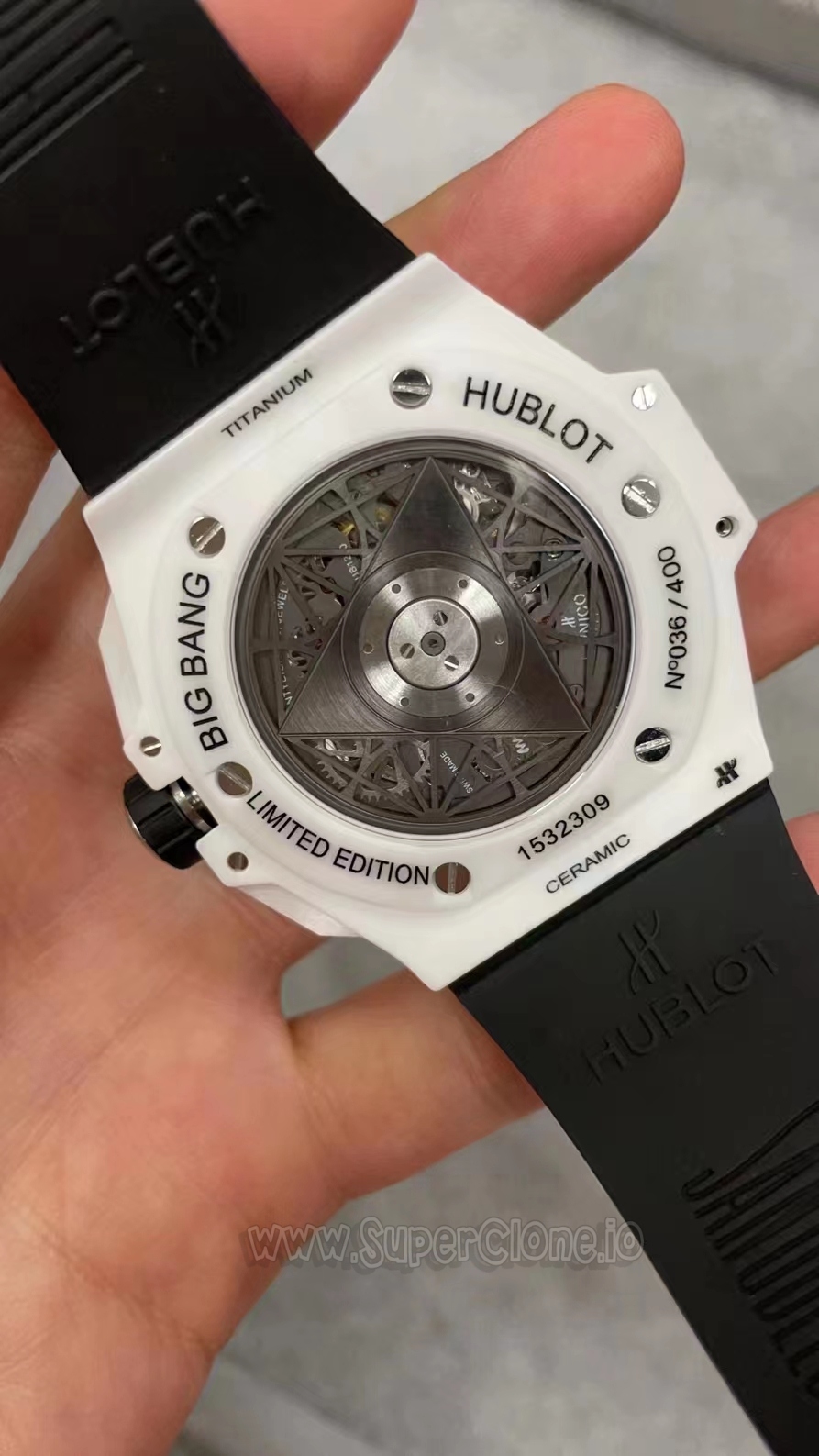
The sapphire crystal also plays a major role in how the watch presents itself. Because the Sang Bleu relies heavily on depth, shadows, and layered surfaces, crystal clarity becomes extremely important. A weak crystal coating or poor transparency would flatten the entire design and reduce the dramatic three-dimensional effect that makes the watch distinctive in the first place.
Movement Decoration, Fineness, and Caseback Aesthetics
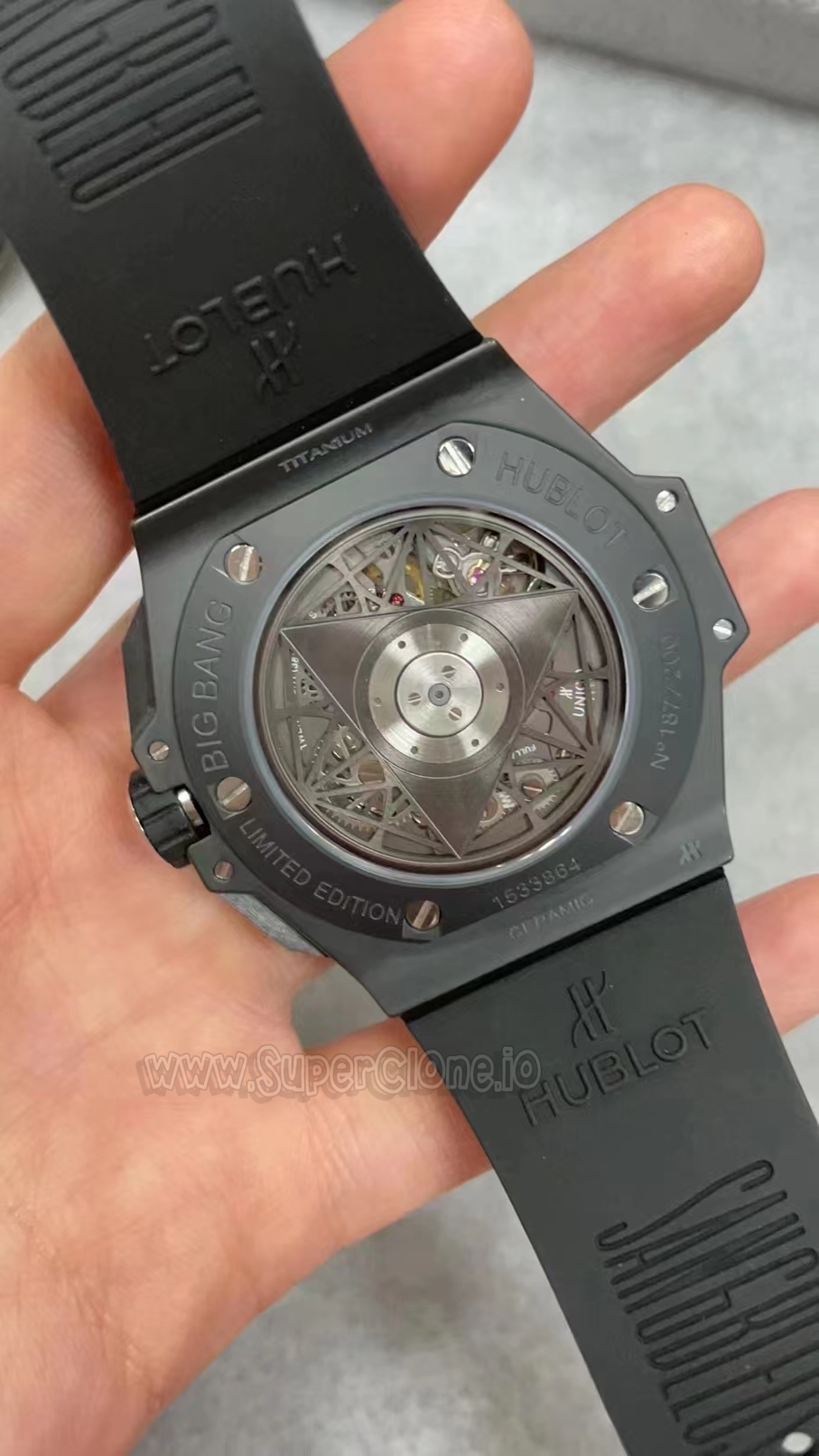
ZF’s movement decoration was another area where collectors noticed improvements compared with several earlier Sang Bleu replicas. While most buyers understand that decorative clone chronograph movements are not identical to genuine Hublot calibers internally, finishing quality still matters because the movement remains fully visible through the sapphire caseback.
Earlier factories sometimes treated movement decoration as secondary. Rotors looked unfinished, bridges lacked depth, and engraving quality often appeared shallow or inconsistent. ZF approached the presentation more carefully. The movement finishing appears cleaner, and the visual architecture better matches the premium positioning the factory aimed for with this release.
In the broader replica watch market, this matters more than casual observers may realize. Buyers in the modern super clone segment no longer focus only on external appearance. Increasingly, collectors examine details such as movement decoration, rotor engraving, bracelet articulation, lume application, ceramic texture, and caseback finishing before deciding which factory deserves long-term trust.
Evolving Standards inside the Super Clone Industry
The rise of higher-end replica manufacturing during the past several years has changed expectations dramatically. Earlier generations of replica buyers were often satisfied if the watch looked convincing from a distance. Modern collectors are far more detail-oriented. Macro photography, comparison videos, Reddit discussions, Telegram groups, and factory-side QC images have pushed the market toward increasingly microscopic evaluation standards.
That evolution partly explains why factories like ZF have expanded aggressively into categories once considered niche or risky. Enthusiasts are no longer interested only in mainstream Rolex sports models. More buyers now look for watches with unusual design language, ceramic construction, skeletonized dials, or architectural cases that stand apart from ordinary luxury sports watches.
The Sang Bleu fits perfectly into that trend because it offers a visual identity almost impossible to confuse with any other modern sports watch. Even people who know very little about watches immediately recognize that the design is unconventional. That uniqueness creates a different type of appeal compared with traditional dive watches or conservative chronographs.
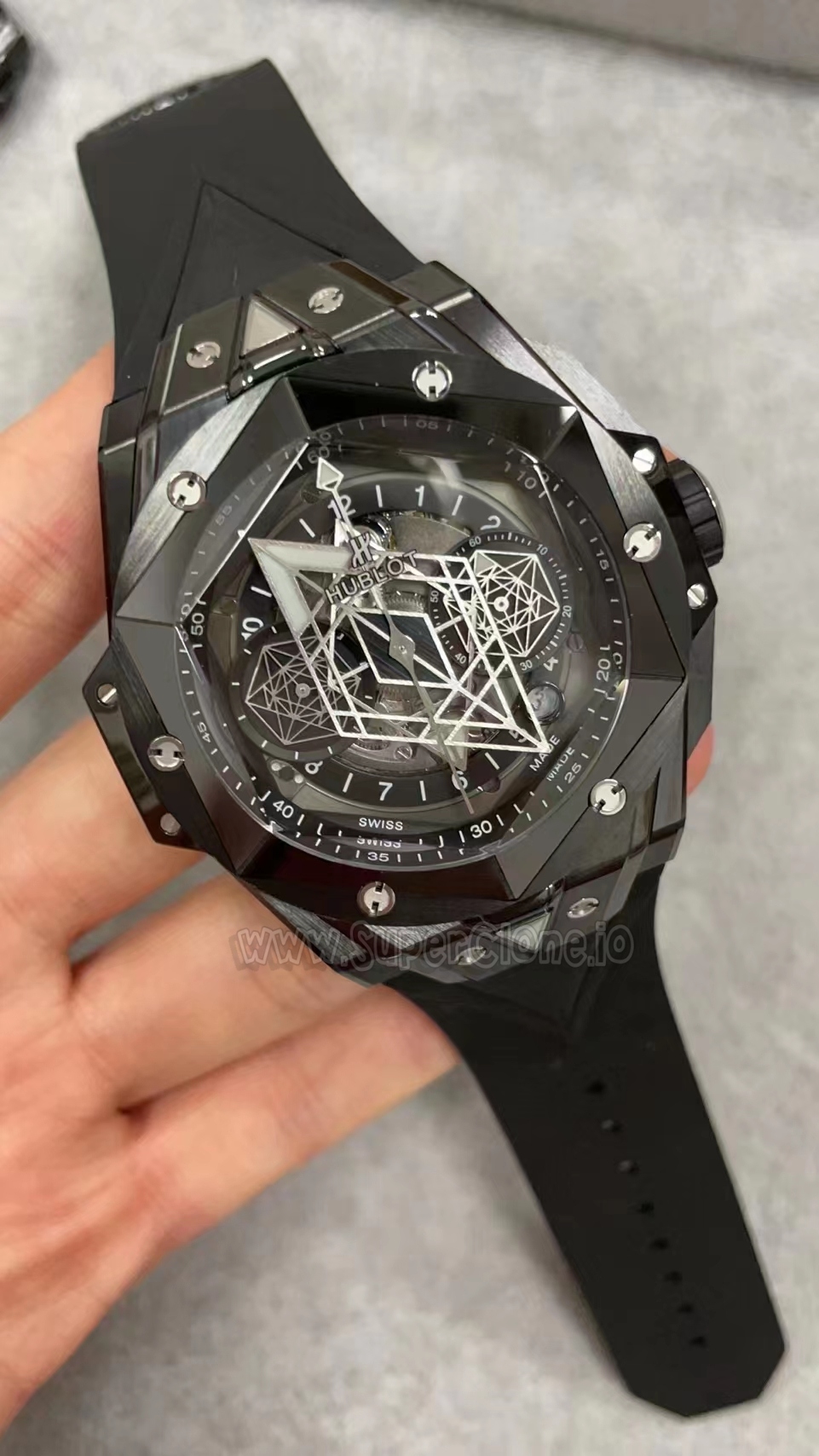
The black ceramic version arguably represents the more understated option despite the watch’s aggressive architecture. Black ceramic softens some of the geometric intensity by reducing contrast between surfaces. Under lower lighting conditions, the watch appears stealthier and more technical. The angular transitions remain visible, but they blend together more naturally than on the white ceramic model.
For many experienced collectors, black ceramic also feels slightly more versatile for daily wear. White ceramic attracts attention instantly and highlights every edge of the case construction, while black ceramic integrates more easily into casual clothing and darker wardrobes. However, preferences in this area are highly subjective because the Sang Bleu was never designed to be subtle in the first place.
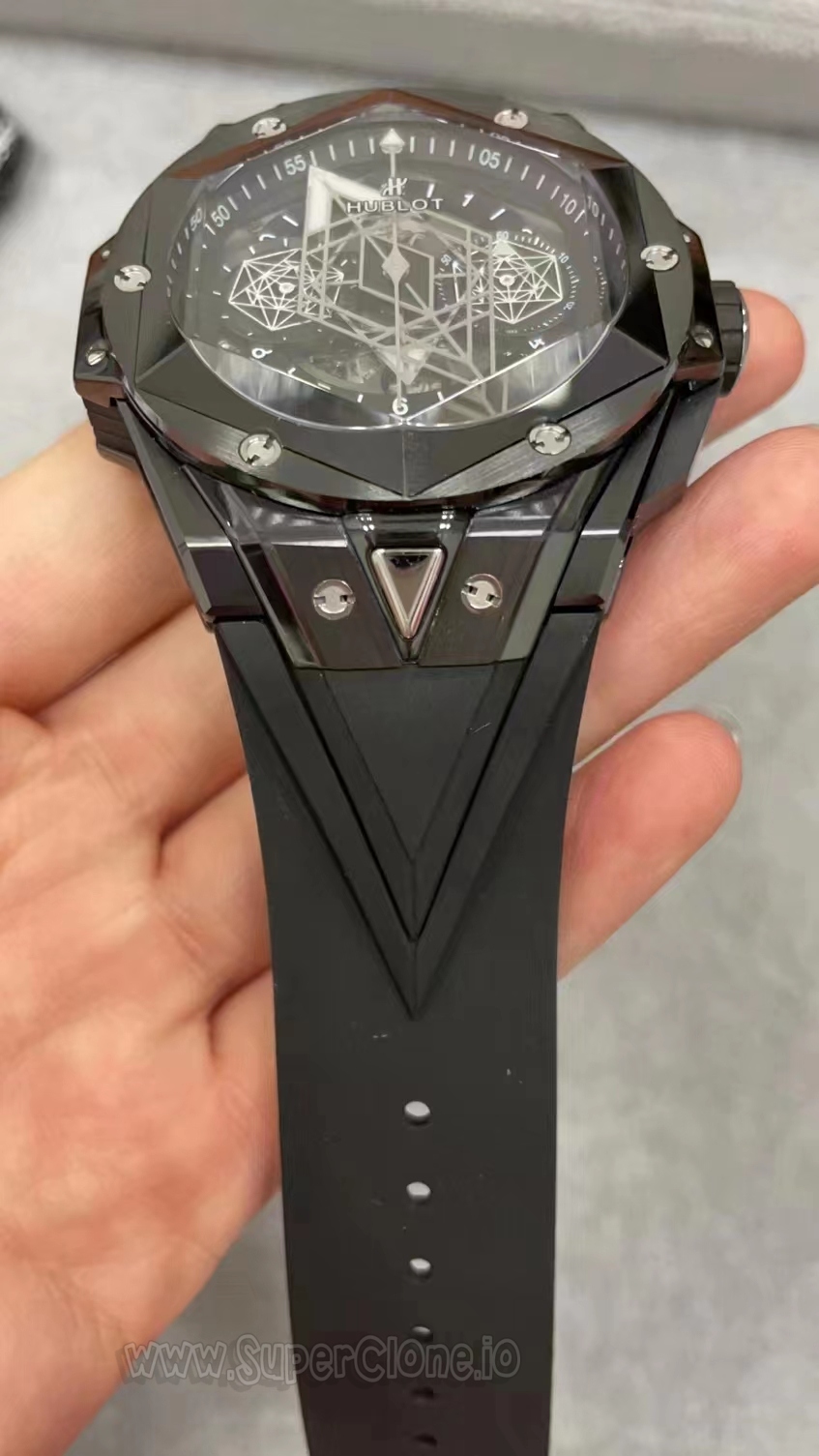
One interesting characteristic of ceramic Hublot replicas in general is how much the finishing quality changes the perceived price level of the watch. Poor ceramic finishing immediately makes a watch feel inexpensive because the surface texture loses depth and the sharp transitions become uneven. Well-finished ceramic, by contrast, creates a much more premium tactile experience. The way light moves across the case edges becomes smoother and more controlled.
Collectors familiar with earlier V6-era Hublot replicas will probably notice that the overall industry standard has changed considerably. During the peak years of V6 factory, Hublot replicas already occupied a relatively advanced position compared with many other replica categories. However, the newer generation of factories operates in a market where buyers expect significantly higher precision in finishing and detailing.
ZF appears aware of that shift. Their Sang Bleu release does not rely only on the novelty of the design itself. The factory clearly attempted to improve overall consistency, especially in areas buyers now examine carefully during QC inspections. Case finishing, movement presentation, bezel geometry, and dial layering all appear more refined than many earlier attempts from competing factories.
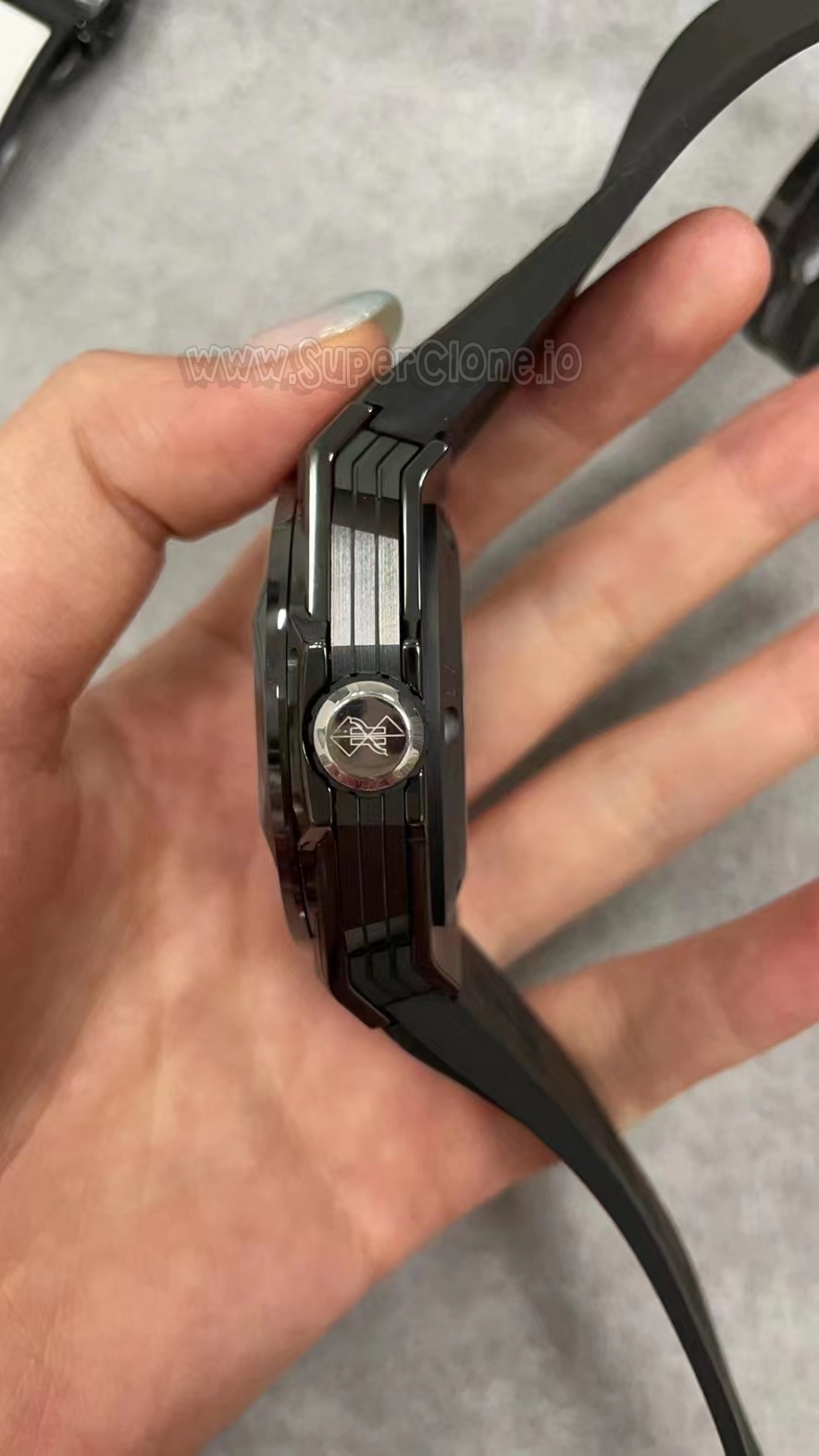
The crown engraving on the black ceramic version deserves separate mention because darker watches often hide details more easily. Despite the darker surfaces, the engraved elements remain relatively crisp and maintain good contrast against the surrounding material. This contributes to the watch feeling cohesive rather than visually unfinished.
Reliability, Selective Luminescence, and Shifting Collector Tastes
Another factor that influences collector perception is after-sales reliability. Within the replica market, factory reputation extends beyond appearance alone. Some factories develop reputations for unstable movements, inconsistent assembly quality, or high rates of return issues. ZF historically gained trust partly because their watches often arrive with fewer immediate quality-control problems compared with lower-tier competitors.
That reputation matters especially for more complex watches like the Sang Bleu. Buyers already accept that unconventional designs introduce additional manufacturing complexity. If the factory also develops a reputation for weak assembly consistency, confidence drops quickly. ZF benefited from entering the Sang Bleu segment with an already established reputation in the enthusiast community.
The luminous details on the dial are subtle but contribute significantly to nighttime visibility. Rather than flooding the entire dial with lume, the design uses selective luminous application in several key locations. This restrained approach actually suits the architectural identity of the watch better than excessive lume coverage would.
The date window at approximately 4:30 remains controversial among some collectors, although that criticism applies to the genuine design as well rather than specifically to the replica. Some enthusiasts prefer perfectly symmetrical chronograph layouts, while others appreciate the asymmetrical placement because it preserves more space for the geometric dial structure.
From a broader market perspective, the success of the Sang Bleu also reflects changing tastes within the replica community itself. For many years, the market focused heavily on conservative watches intended primarily to imitate mainstream luxury status symbols. More recently, however, collectors increasingly appreciate watches with stronger individual identity.
Hublot occupies a unique place in that evolution because the brand itself has always leaned heavily toward unconventional case materials, aggressive styling, and modern sports-luxury experimentation. That makes Hublot replicas particularly dependent on finishing quality. A conservative watch can sometimes survive minor imperfections because the design itself remains simple. A watch like the Sang Bleu cannot hide flaws so easily.
Every sharp edge, polished transition, and geometric alignment point becomes part of the visual experience. Even small inaccuracies affect the entire impression of the watch. That is why experienced collectors paid attention when ZF released a Sang Bleu that finally looked more mature and coherent than many earlier attempts in the segment.
The Evolution Beyond Basic Visual Imitation
The visible movement architecture through the sapphire caseback reinforces the technical identity of the watch. While no experienced collector mistakes these decorated clone movements for genuine Hublot calibers internally, visual finishing quality still influences overall ownership satisfaction. The rotor design, bridge finishing, engraving sharpness, and balance of exposed components all contribute to the premium illusion that modern super clone buyers expect.
What makes the Sang Bleu particularly interesting in today’s replica market is that it represents more than a single product release. It reflects a broader transition inside the industry itself. Factories are gradually moving beyond simple replication of mainstream luxury icons and entering categories where design complexity, finishing quality, and material execution matter just as much as recognizable branding.
For collectors who already own multiple Submariners, Daytonas, or Royal Oaks, the Sang Bleu offers something visually different. It does not attempt to disappear into the background. The watch is intentionally sculptural, highly geometric, and instantly recognizable from across a room.
Whether someone personally enjoys the design is ultimately subjective. Some collectors still prefer traditional sports watch proportions and simpler dial layouts. Others appreciate the Sang Bleu precisely because it rejects those conventions. Either way, ZF’s ceramic versions demonstrated that the replica market had reached a point where even highly unconventional luxury sports watches could receive serious attention to detail.
That is probably the most important aspect of this release. The Sang Bleu was never going to become a universal daily watch for every collector. Instead, it became evidence that replica manufacturing standards in the upper tier of the market had evolved well beyond basic visual imitation. Ceramic finishing, movement presentation, architectural geometry, and overall construction quality are now central parts of the conversation.
And for many enthusiasts watching the modern Hublot replica segment evolve after the decline of older factories, that shift may matter more than the watch itself.
