
The Power Vacuum: How OR Factory Seized the Seamaster Market
Anyone talking about Omega Seamaster 300M replicas would eventually mention VS Factory. In the modern Seamaster market, VS had already established something close to a default position among buyers. Whether it was the cloned 8800 movement structure, ceramic dial texture, or overall case proportions, VS spent years building a reputation that few factories could seriously challenge.
Ironically, that dominance also created a strange vacuum once VS temporarily disappeared from the market. Collectors suddenly realized that watches which used to be available anytime had become difficult to source, and delivery times on popular Seamaster models started stretching longer and longer. During that period, several smaller factories quietly entered the conversation, and OR Factory became one of the few names people unexpectedly started paying attention to. It wasn’t that OR was an unknown entity before, but rather that few serious buyers had considered it a primary choice when VS was readily available.
The Green Seamaster: An Unexpected Market Disrupter
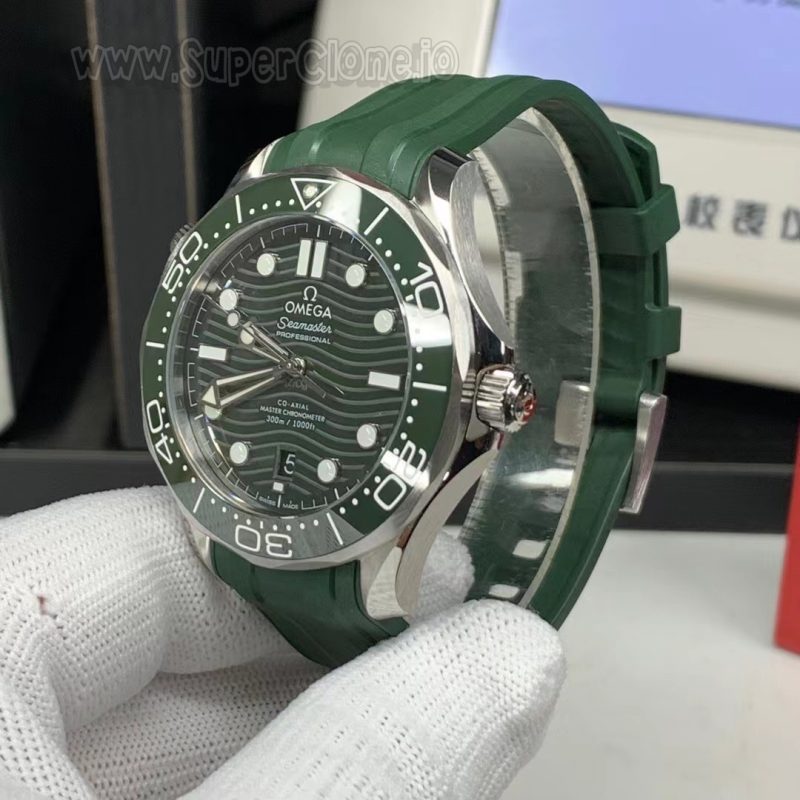
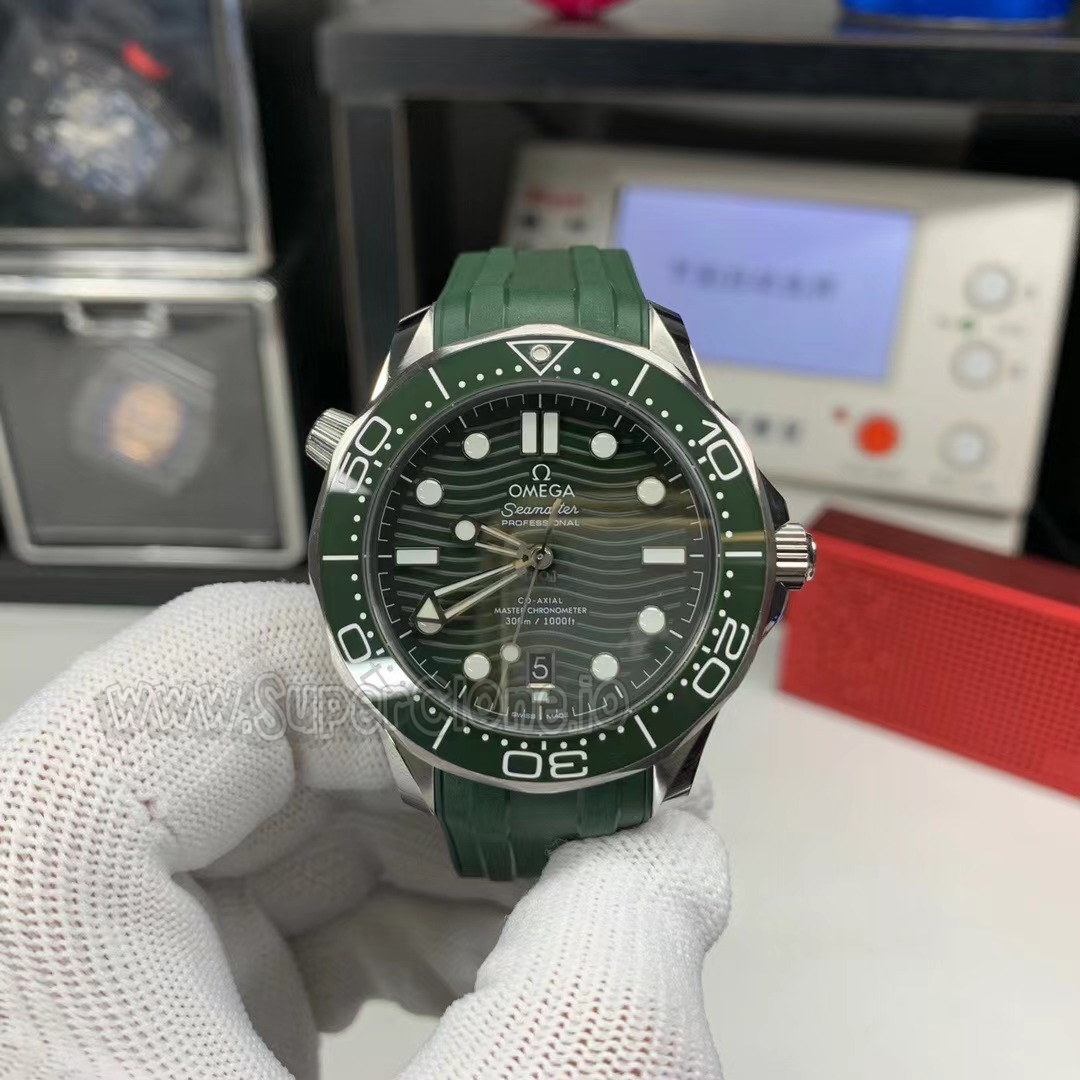
This green Omega Seamaster 300M belongs to that exact phase of the market. Honestly, green has never been the safest color choice in the Seamaster lineup. Black and blue remain the mainstream options because they feel easier to wear daily, while green always carried a slightly more niche personality. Many collectors initially treated this version as Omega simply experimenting with color variety rather than creating a true long-term staple. That perception, however, is precisely what made it an ideal candidate for a factory looking to differentiate itself.
But limited availability changes perception very quickly in the replica industry. Once buyers realized VS Factory never released this green ceramic version, the watch suddenly became more interesting. VS had already covered nearly every important Seamaster variation at the time, from standard black dial models to blue versions and even the No Time To Die editions. The absence of this particular green Seamaster created an unusual opening in the market, and OR Factory moved into that space at the perfect moment. They didn’t have to beat VS on every single metric; they simply had to offer a compelling product that was actually obtainable.
OR Factory gained traction during the exact period when VS was struggling with supply interruptions. Before that, most serious Seamaster buyers rarely considered OR because VS had already become deeply associated with high-end Omega production. However, market reality slowly changed buyer behavior. VS orders became increasingly difficult to obtain, waiting periods grew longer, and some collectors simply wanted an alternative that could actually be delivered. It’s a classic case of market demand shifting to fill a void left by the former leader.
Market Reality Check: When a dominant player goes quiet, physical availability and delivery speed become just as crucial to collectors as incremental aesthetic upgrades.
That is where OR started gaining momentum. Their Seamaster models entered the market at lower prices, with faster availability, while still maintaining surprisingly respectable overall quality. More importantly, very few factories were attempting this green ceramic Seamaster seriously at the time, which allowed OR to stand out more than they normally would have. The strategy was straightforward: identify a desirable reference that the market leader overlooked, and execute it competently enough to satisfy impatient collectors.
Ceramic Dial and Bezel: Where OR Made the Right Decisions
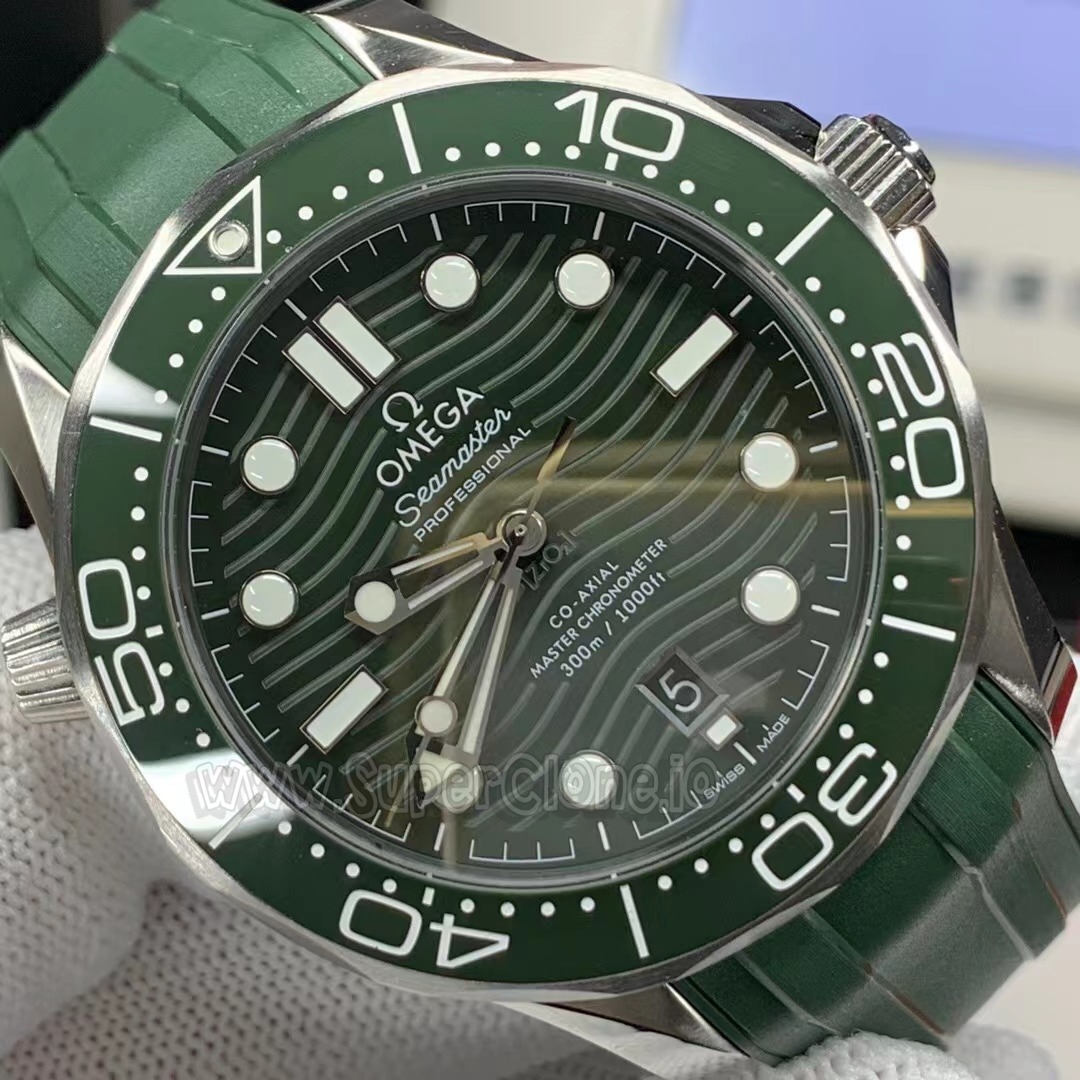
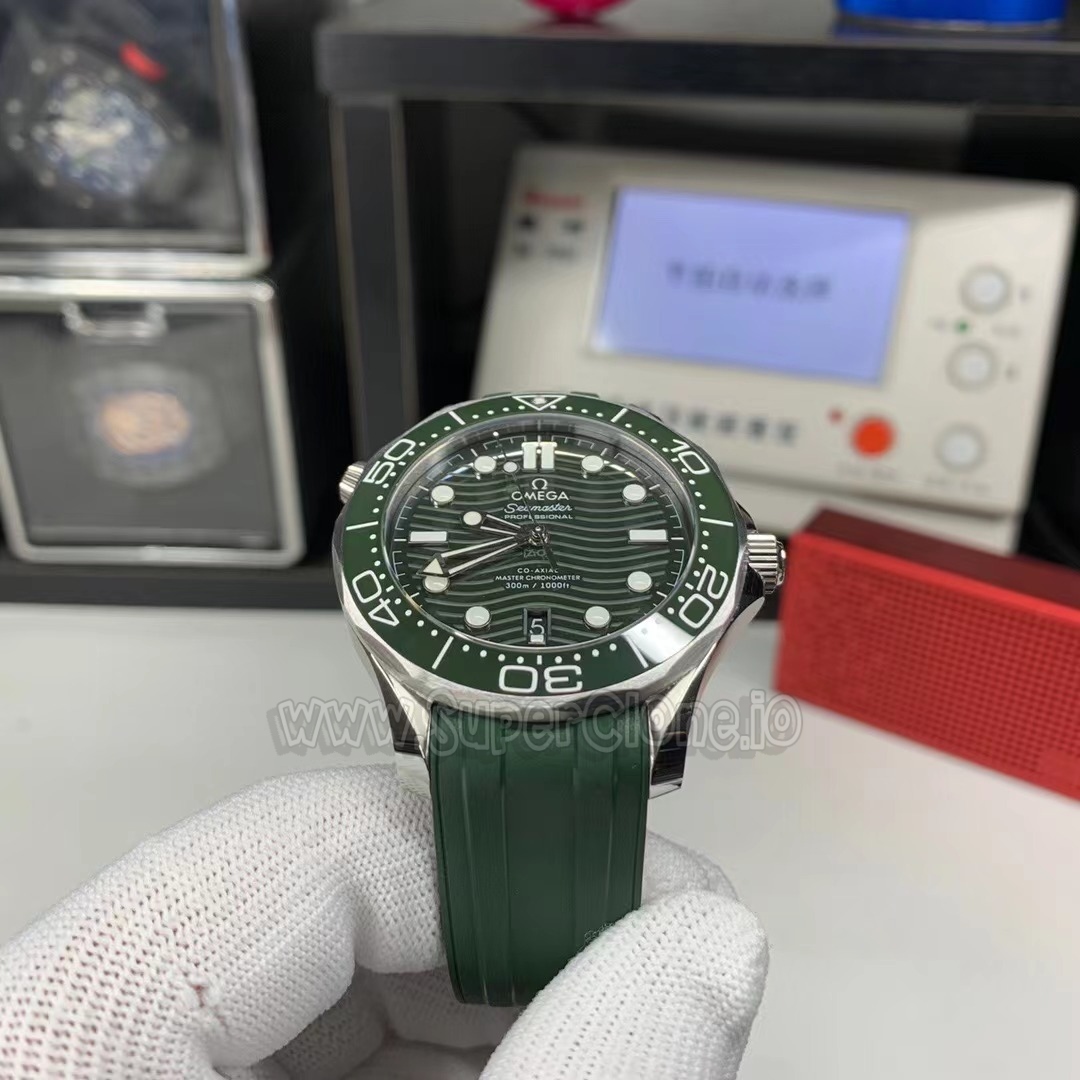
The strongest visual feature of this watch is not actually the bezel, but the ceramic dial itself. The green tone here is darker than many people expect from online photos. Under indoor lighting, the watch appears relatively restrained and almost muted, while the wave-pattern texture becomes much more visible under stronger direct light. This duality is one of its strongest selling points—it’s subtle enough for daily wear but reveals its true character when the light hits just right.
The concentric wave lines across the dial surface are pressed with consistent depth—a crucial detail that cheaper factories often get wrong by making the grooves either too shallow or uneven across the surface. OR handled the color surprisingly carefully. They avoided making the green overly bright or glossy, which is a common mistake among lower-end factories attempting colored ceramic dials. The saturation sits at a level that reads as deep forest green rather than the overly vivid tone found on budget alternatives. Instead, the watch keeps a deeper tone that feels much closer to the genuine Seamaster’s understated appearance.
The ceramic bezel insert follows the same approach and avoids the cheap plastic-like reflection that often ruins lower-quality replicas. The minute graduation markings on the bezel remain sharp with clean edges, and the zero marker lume pip holds its fill without blurring. The bezel action itself is crisp, with 120 clicks that feel solid and well-defined, though perhaps not quite as buttery smooth as the genuine or VS’s best efforts. Still, for the price point, it’s more than acceptable.
Case Construction, Geometry, and Proportions
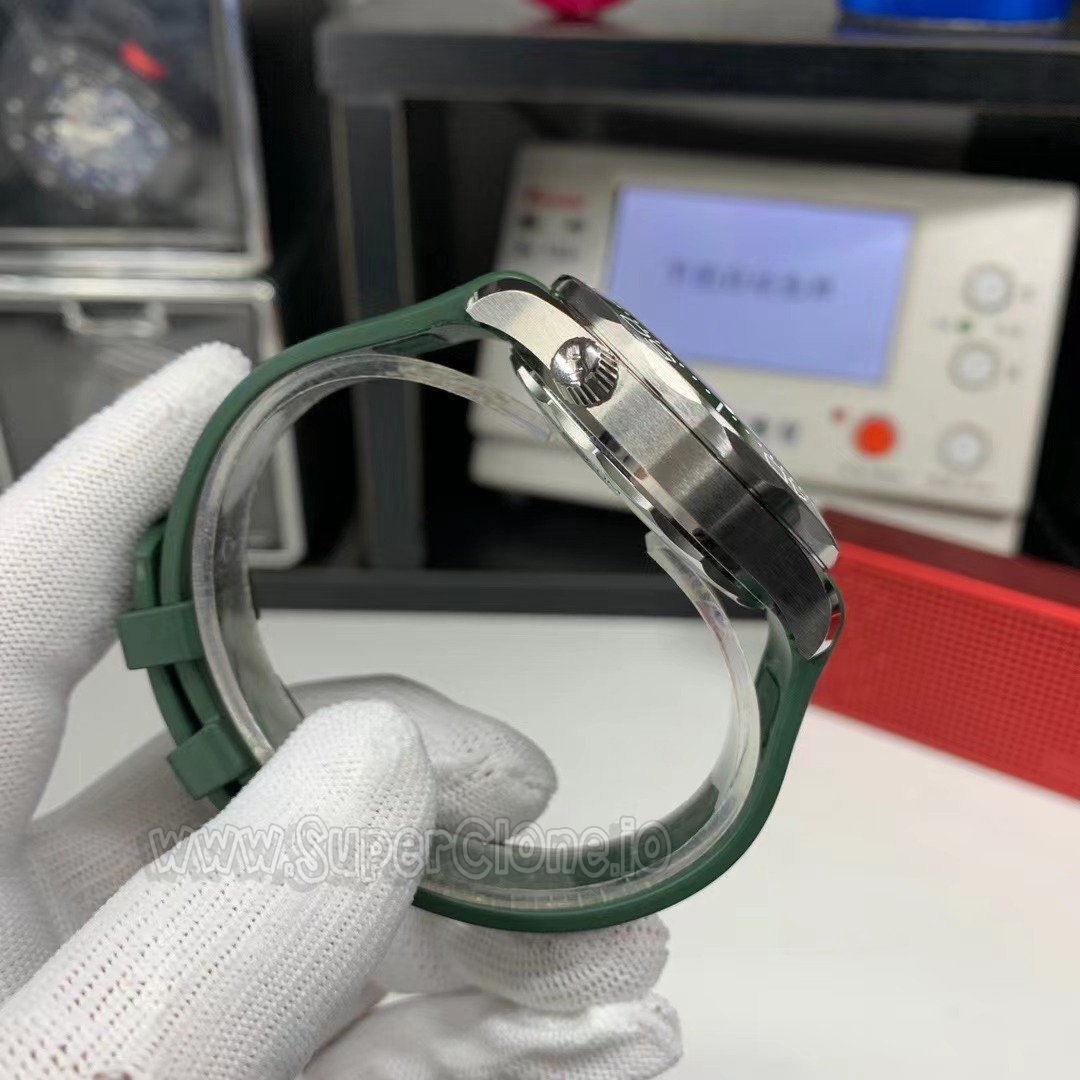
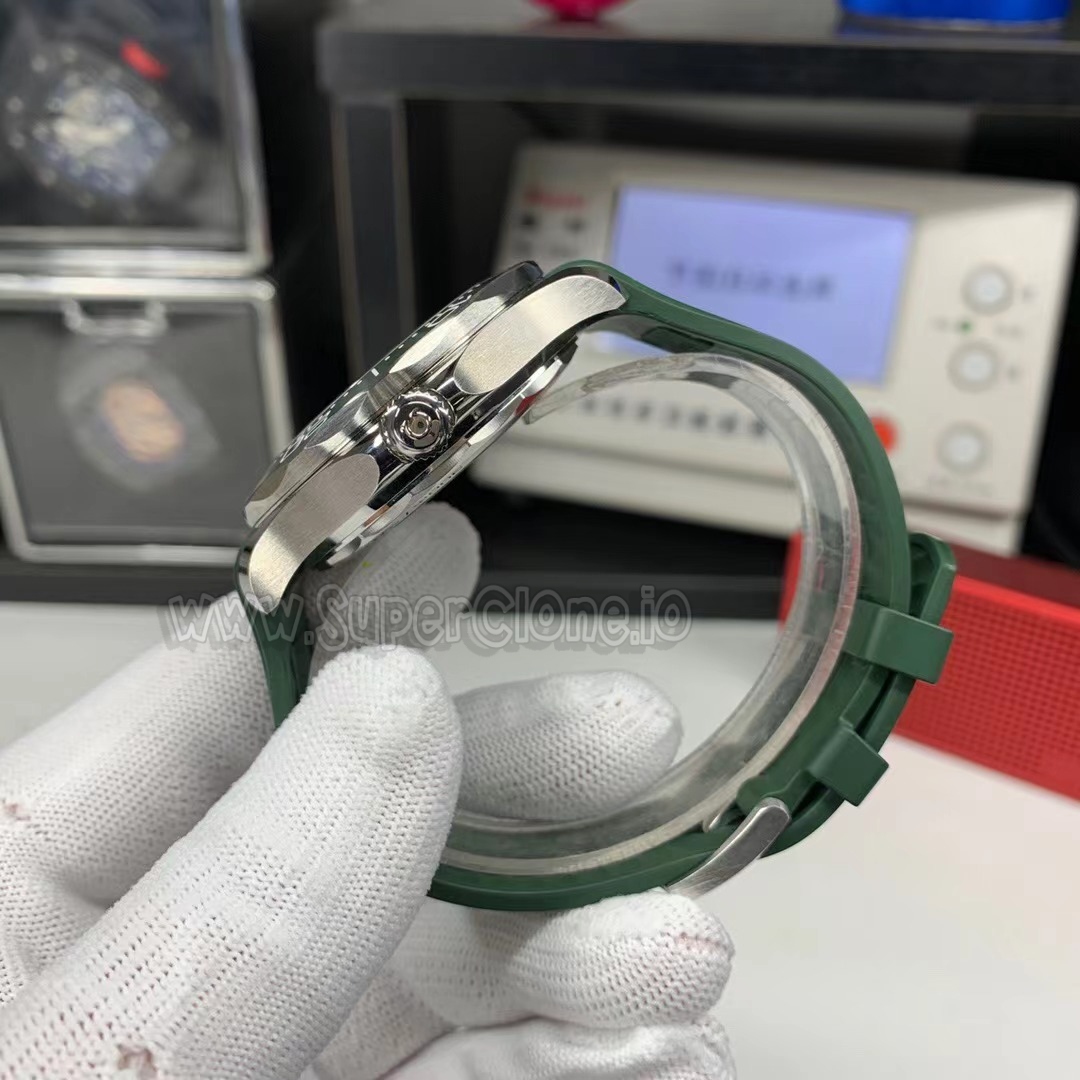
Modern high-end replica production has changed dramatically compared to just a few years ago. Factories are no longer focused only on whether a watch looks similar from the front. Today, experienced buyers pay attention to case thickness, lug curvature, side profile proportions, and even the way the bracelet integrates into the case. The true “tell” of a replica is increasingly found in this three-dimensional geometry, not just the flat printed details.
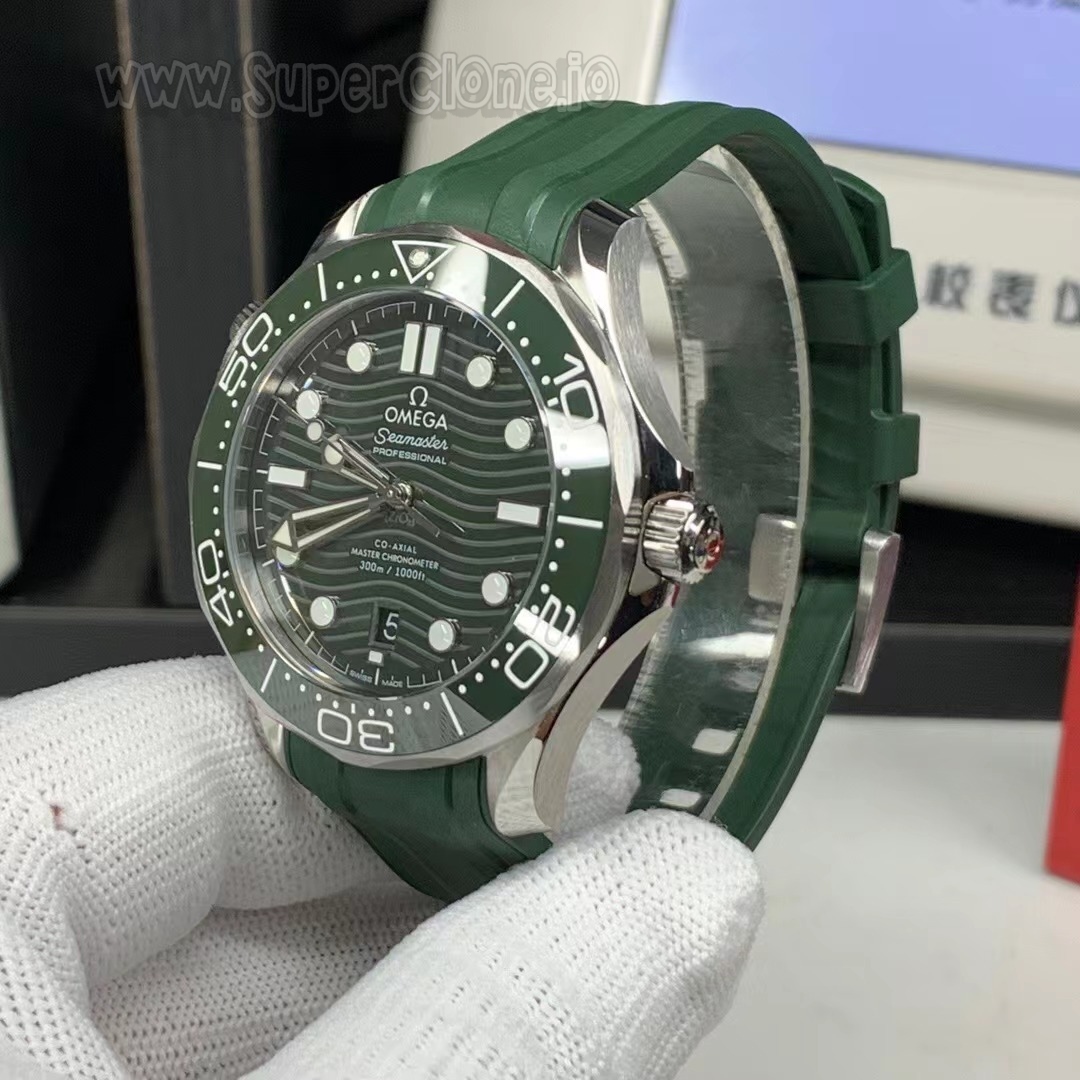
This OR Seamaster uses a solid 316L stainless steel case with the expected 42mm diameter and roughly 13mm thickness. More importantly, it avoids the overly thick side profile that plagued many older Seamaster replicas. The case proportions feel balanced on the wrist, and the transition between the lugs and bracelet remains relatively clean without appearing bulky. This is an area where even some more established factories have stumbled, so OR deserves credit for getting the fundamental architecture right.
The helium escape valve at nine o’clock sits flush with the case middle and rotates with the right amount of resistance—not loose enough to feel cheap, and not stiff enough to require tools. Meanwhile, the crown at four o’clock uses a screw-down mechanism that threads smoothly through two full turns before engaging resistance. Pulling and pushing between the winding and time-setting positions has a positive, defined action. Some factories produce crowns that feel hollow or produce a grinding sensation during operation, but the OR version avoids both issues.
Some factories now even advertise that their cases can interchange with genuine parts, which may sound exaggerated at times, but it reflects how much the replica market has evolved. Years ago, buyers mainly cared about dial appearance. Today, experienced collectors immediately inspect case geometry, bezel angles, and overall dimensions before anything else. On this front, OR’s case is a competent effort that passes the visual and tactile inspection for most enthusiasts.
Dial Details, Lume, and Crystal Coating
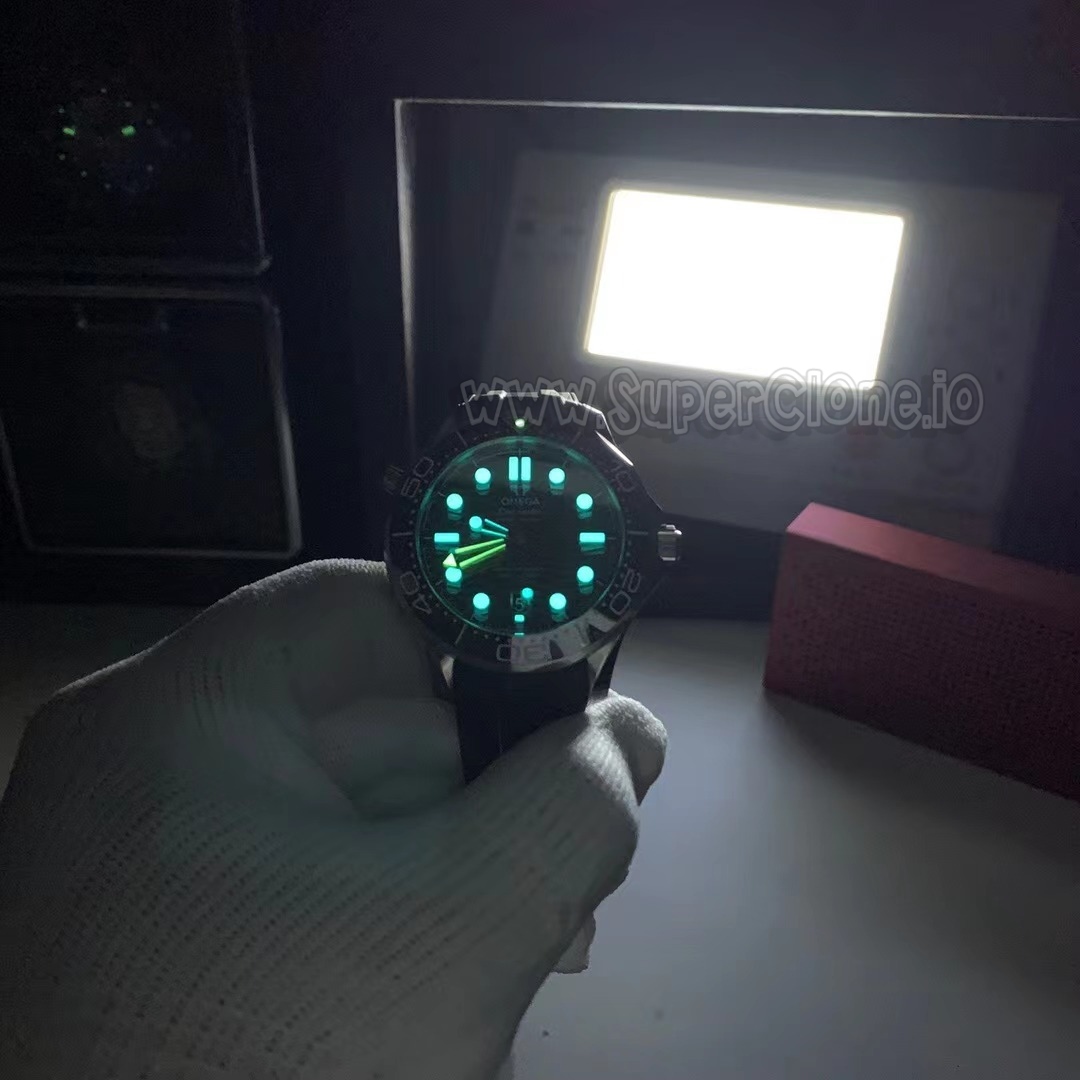
The dial lume follows the typical Seamaster design language. The silver-framed hour markers leave enough internal space for strong luminous filling, while the skeleton hands also receive full lume application. The lume color is a consistent blue-green, matching the warm cream-to-green glow expected from the genuine Seamaster rather than the cold, blinding white charge found on lower-tier replicas. Visibility in dark conditions remains impressive. After charging under direct light for roughly thirty seconds, the markers remain clearly readable in complete darkness for well over an hour.
The sapphire crystal performance also matters heavily on any Seamaster 300M replica because the genuine watch relies strongly on anti-reflective coating quality. Poor coating instantly makes the entire dial feel flat and inexpensive, drawing immediate negative attention in person. OR does not fully match the consistency VS eventually achieved on later versions, but the crystal avoids the overly blue coating effect that often gives away cheaper replicas immediately. Under most lighting conditions, the crystal reads as nearly invisible, allowing the wave dial texture and hands to remain the true visual focus.
The Cloned 8800 Movement Architecture
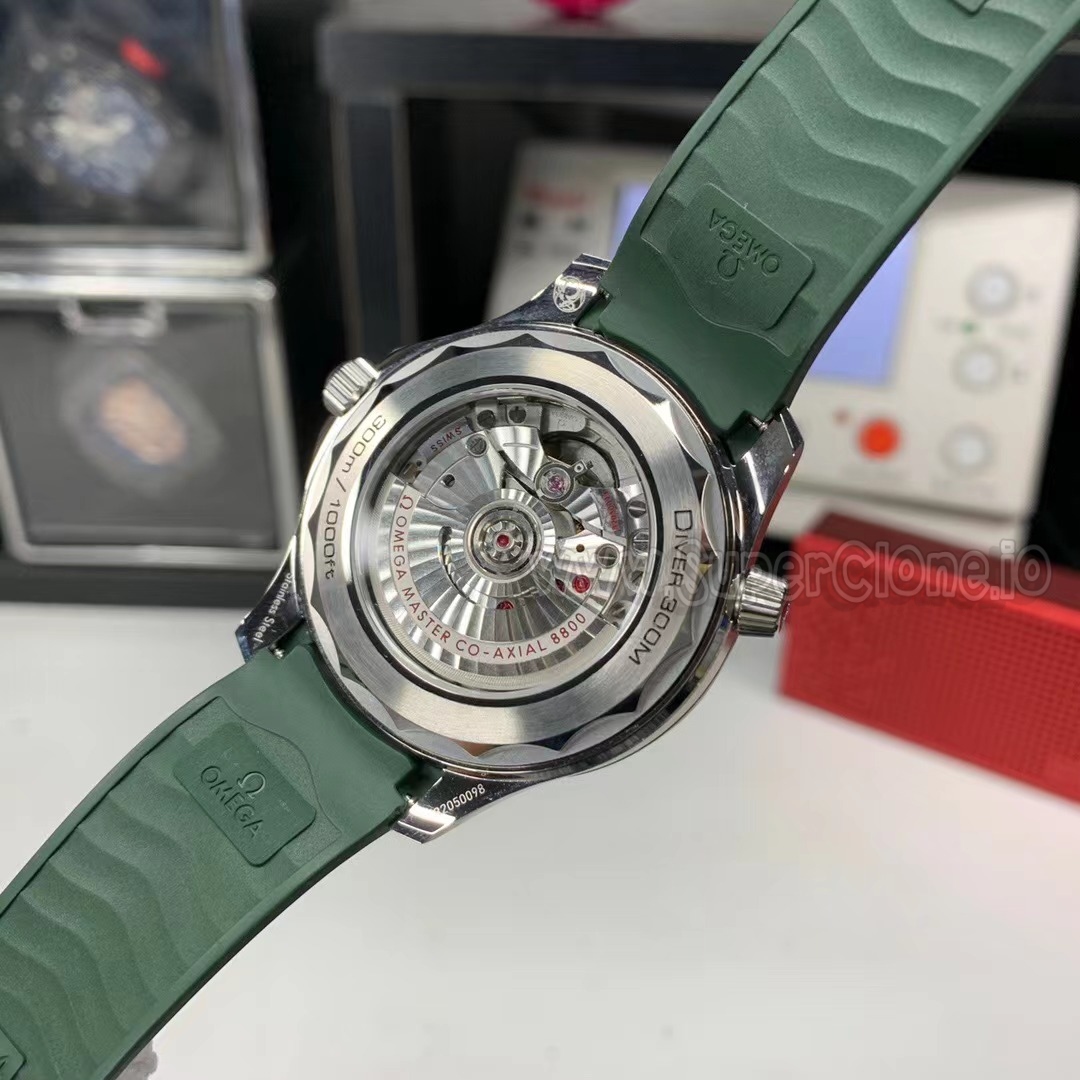
Inside the watch is a cloned Omega 8800 automatic movement, one of the most important elements in the entire Seamaster replica ecosystem. Since the Seamaster uses a display caseback, movement appearance plays a major role in overall realism. Unlike a solid caseback that hides everything, the Seamaster’s exhibition rear means the rotor, bridges, and finishing are fully exposed to inspection at any moment.
VS Factory spent enormous resources developing their cloned 8800 movement, which is why their Seamaster models became so dominant for years. From the rotor structure to the decorative finishing and bridge layout, VS achieved a level of visual accuracy that most competitors struggled to approach. Their movement was a genuine breakthrough in the replica industry, setting a benchmark that others are still trying to catch up to. The Geneva stripes on VS movements catch light correctly, and the rotor weight carries the right mass when the wrist is moved.
The OR version still falls slightly behind VS in finer movement details. Specifically, the anglage along the bridge edges is less defined, and the Geneva striping pattern appears shallower under magnification compared to the VS equivalent. The rotor also carries slightly less visual weight, which subtly changes the way it swings during wrist movement. These differences become apparent when examined side by side, but they are far less obvious to anyone not specifically comparing movements under a loupe.
Where the OR version solves the problem correctly is in two critical areas. First, the movement architecture no longer looks obviously incorrect the moment the caseback is viewed. The overall layout, rotor position, and bridge arrangement are accurate enough that a brief glance through the glass reads convincingly. Second, and more importantly, it allows the watch to maintain proper overall thickness. Many lower-quality Seamaster replicas fail not because of the dial, but because oversized movements force the case profile to become unrealistically thick, immediately giving away the watch from the side profile alone.
Bracelet, Rubber Strap, and Daily Wrist Presence
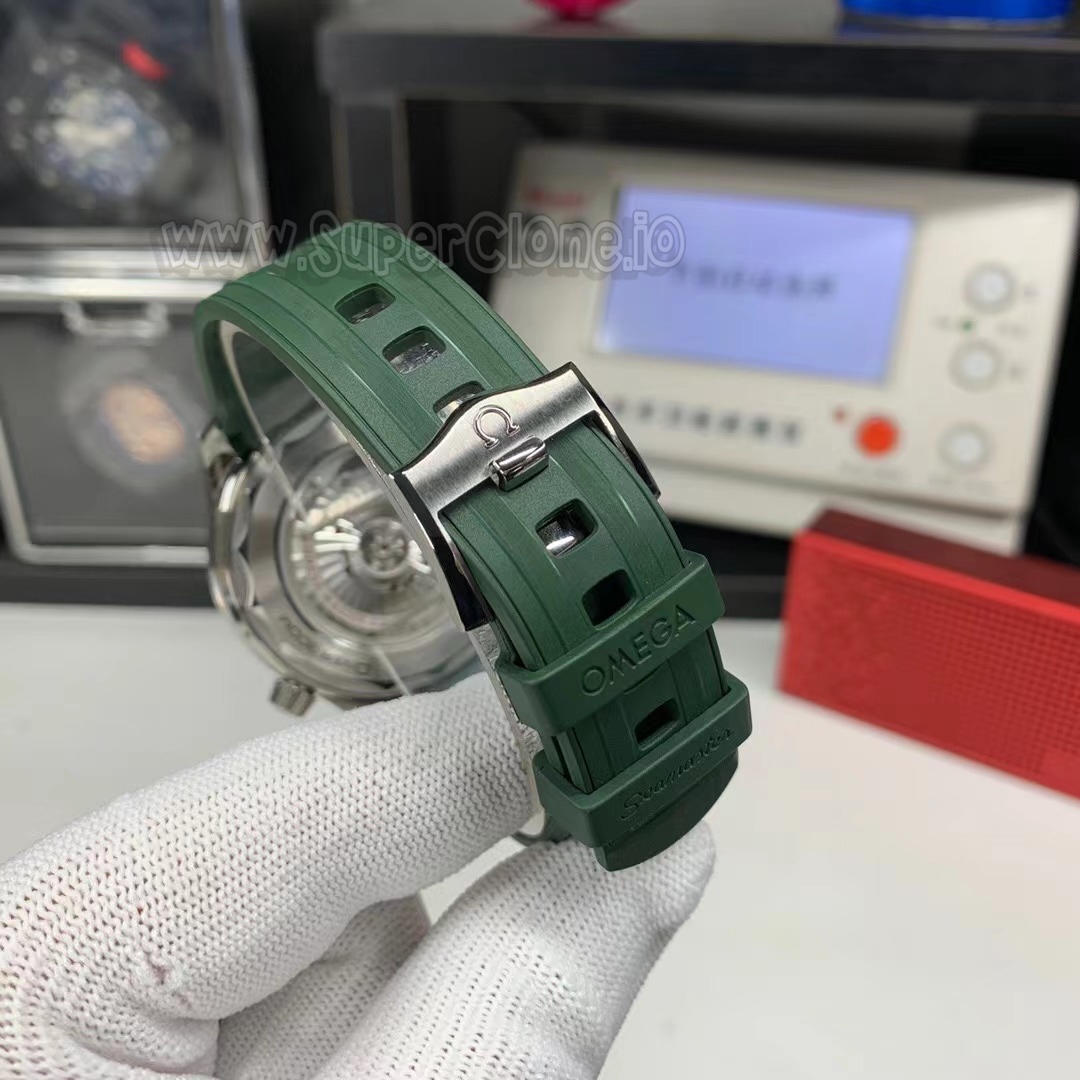
Most OR green Seamaster models are sold on a stainless steel bracelet while also including a matching green rubber strap. The steel bracelet uses solid end links that connect to the case with a satisfying click, and the micro-adjustment clasp allows for quick sizing changes without requiring tools. On a medium-sized wrist, the bracelet drapes with minimal gap between links, which contributes to a premium wearing feel compared to cheaper bracelets that splay outward under the weight of the watch.
In actual daily wear, the rubber strap arguably suits the green color better and gives the watch a more aggressive sports-oriented personality, especially during summer. The strap material is firm without being stiff, and it flexes naturally through wrist movement without the cracking or cheap resistance that plagues lower-quality rubber alternatives. Still, many buyers prefer purchasing the steel bracelet version first because it offers greater long-term flexibility, and high-quality aftermarket rubber straps are always easier to source than steel bracelets.
The overall wrist presence of this watch sits at the expected level for a 42mm dive watch. It reads as substantial without crossing into oversized territory, and the lug-to-lug measurement falls correctly within range for wrists anywhere from 16cm upward. Buyers with smaller wrists who find the standard Seamaster 300M slightly large on the genuine version will find the same fit concern applies here, as OR accurately maintains the original proportions rather than scaling the case down.
What makes this watch interesting today is that green never became the mainstream Seamaster color, yet that is exactly why it aged differently from the standard black dial models. Black Seamaster versions are everywhere now, while the green ceramic edition still feels relatively uncommon even among experienced collectors. This relative scarcity of supply gives the green version a different kind of appeal—it reads as a deliberate choice rather than a default option.
A Lesson in Market Positioning
Looking back now, the importance of this OR Factory Seamaster was never simply about whether it perfectly matched the genuine watch. Its significance came from timing and from filling a specific gap that existed nowhere else in the market at the time. It arrived during a window when the dominant player was temporarily absent, and it managed to fill that gap more successfully than many expected—largely because OR made conservative, careful choices rather than cutting corners on the elements that experienced buyers examine most critically.
OR Factory did not permanently reshape the Seamaster replica market, and VS eventually returned with refined production across their full lineup. But this green ceramic version quietly became one of the more interesting alternatives available during that unusual period. For buyers unwilling to wait months for a VS delivery, it offered a balance between quality, availability, and pricing that made practical sense. It wasn’t about being absolutely perfect; it was about being the right watch at the right time.
Even today, the green Seamaster remains one of the few versions in the entire Seamaster 300M lineup that experienced collectors can instantly recognize from across the room without mistaking it for another standard black diver. That distinctive color, combined with the unique story behind its emergence, ensures that it occupies a unique place in the modern replica landscape—not as a direct competitor to VS, but as a highly successful case study in market positioning and opportunistic execution.
