
GM Factory’s Arabic Rolex Day-Date Shows How Far Modern Day-Date Replicas Have Evolved
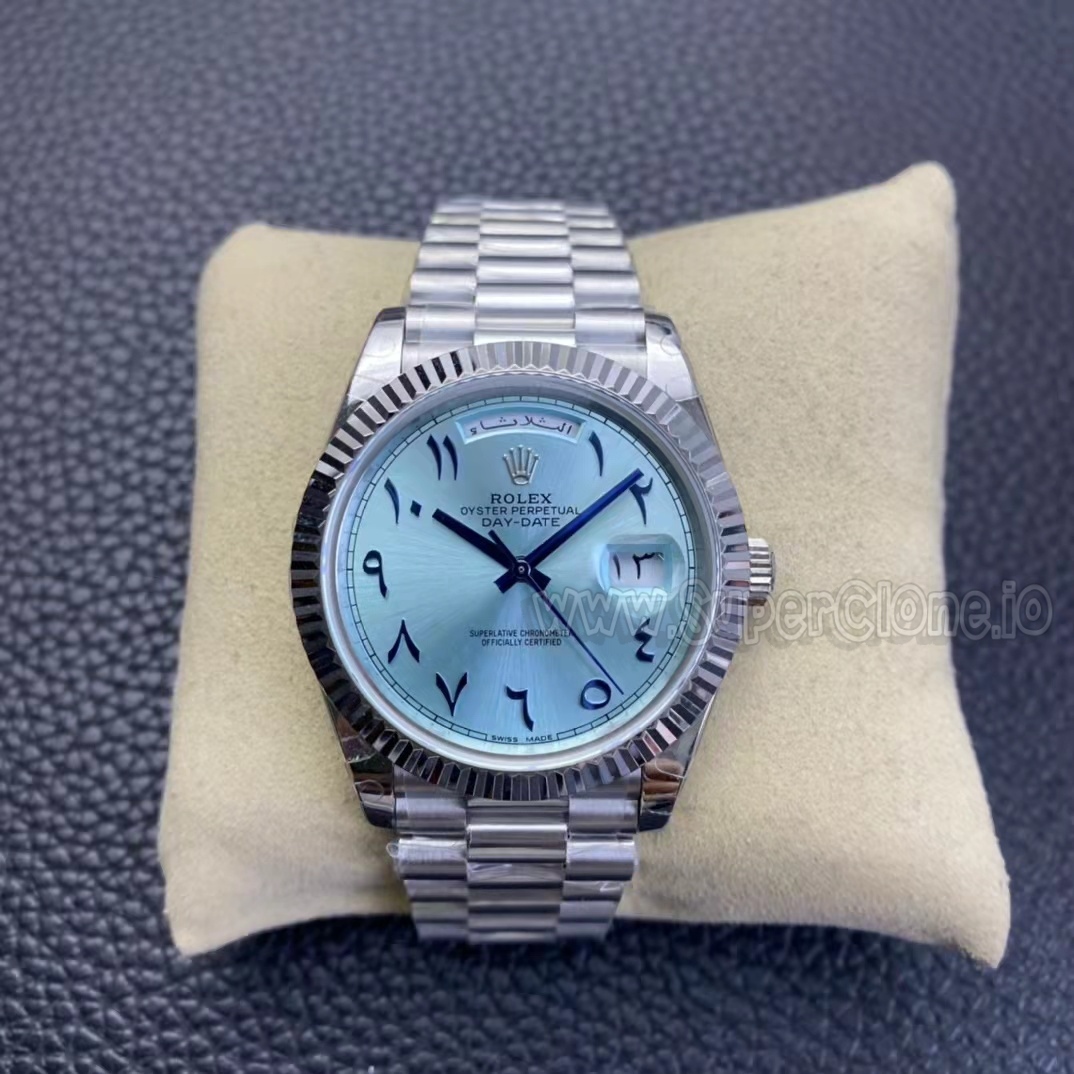
For a long time, most discussions around replica Rolex watches focused almost entirely on mainstream stainless steel sports models. Submariner, GMT-Master II, Daytona, and occasionally Datejust dominated the market because factories knew these references had the largest global demand. Collectors who entered the super clone world several years ago probably remember how difficult it was to even find a properly finished Day-Date replica that did not immediately reveal obvious flaws through bezel shape, bracelet weight, or poorly aligned day windows.
That situation has changed significantly over the last few years.
As movement factories improved clone calibers and manufacturers started competing on smaller details instead of only exterior appearance, the Day-Date category slowly became one of the most technically interesting segments in the replica industry. Unlike a Submariner or Explorer, the Day-Date requires factories to solve several problems simultaneously: correct day switching, proportional date font, realistic bracelet finishing, proper dial texture, and convincing precious-metal visual tone. Once factories began addressing those areas seriously, more niche Day-Date variations also started appearing.
Middle East Edition Replicas: A Distinct Aesthetic Direction
One of the more unusual directions was the emergence of Middle East edition Rolex replicas.
These watches are not simply standard Day-Date models with different hour markers. They represent a specific aesthetic that has existed for years inside certain regional markets, especially among collectors who prefer Arabic typography and culturally distinctive dial layouts. Genuine Rolex models featuring Arabic numerals or Arabic day wheels have always attracted a smaller but very loyal collector base, particularly in Gulf countries where ice blue dials, platinum-style configurations, and special regional editions often carry strong appeal.
In the replica market, these versions remained uncommon for a long time because factories usually prioritized high-volume references first. Producing niche Arabic dials requires extra dial tooling, custom day wheels, and different printing alignment standards. Most factories simply did not consider it commercially necessary.
That is why this GM Factory Rolex Day-Date became surprisingly interesting when it first appeared.
Dial Engineering: Ice Blue Palette and Typography Scrutiny
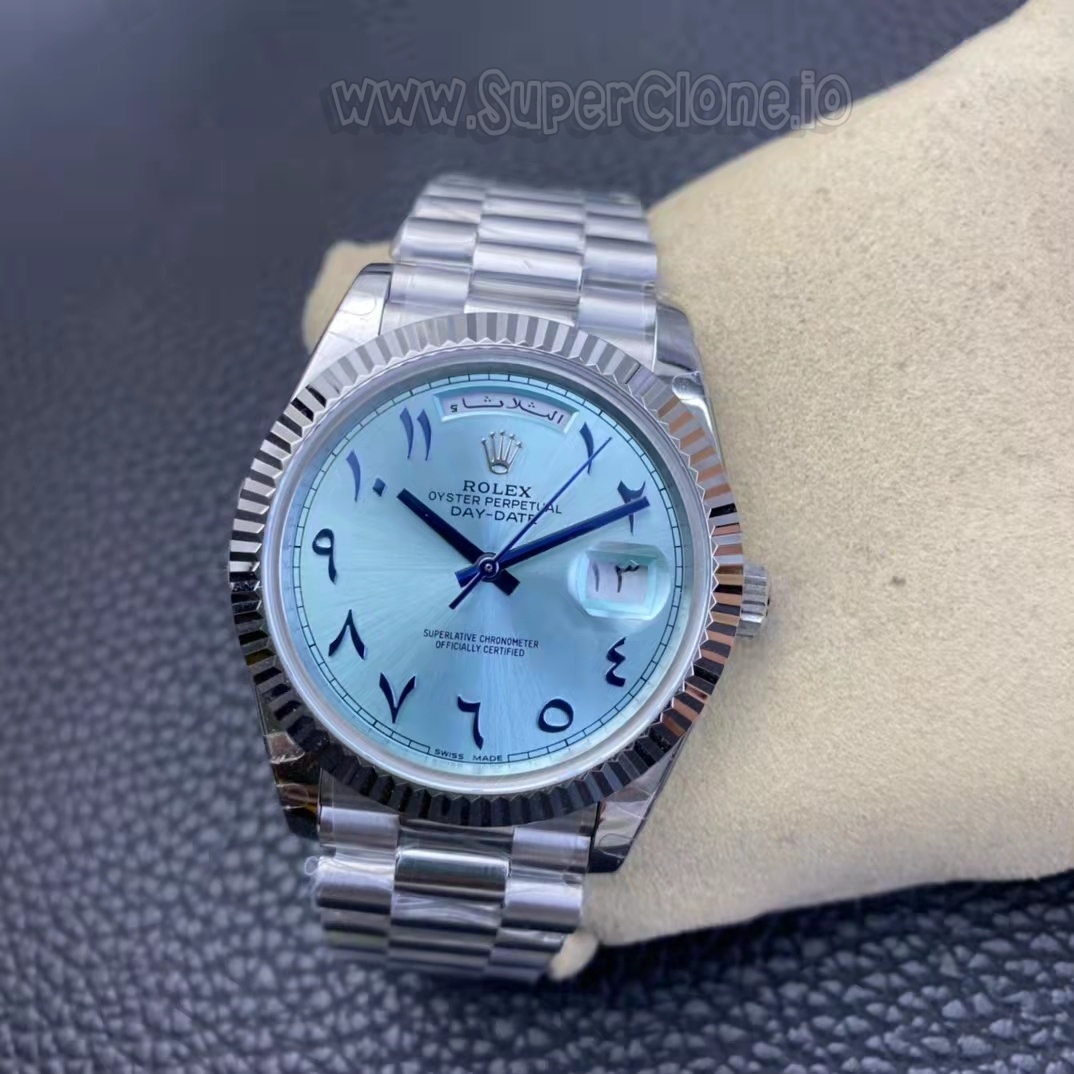
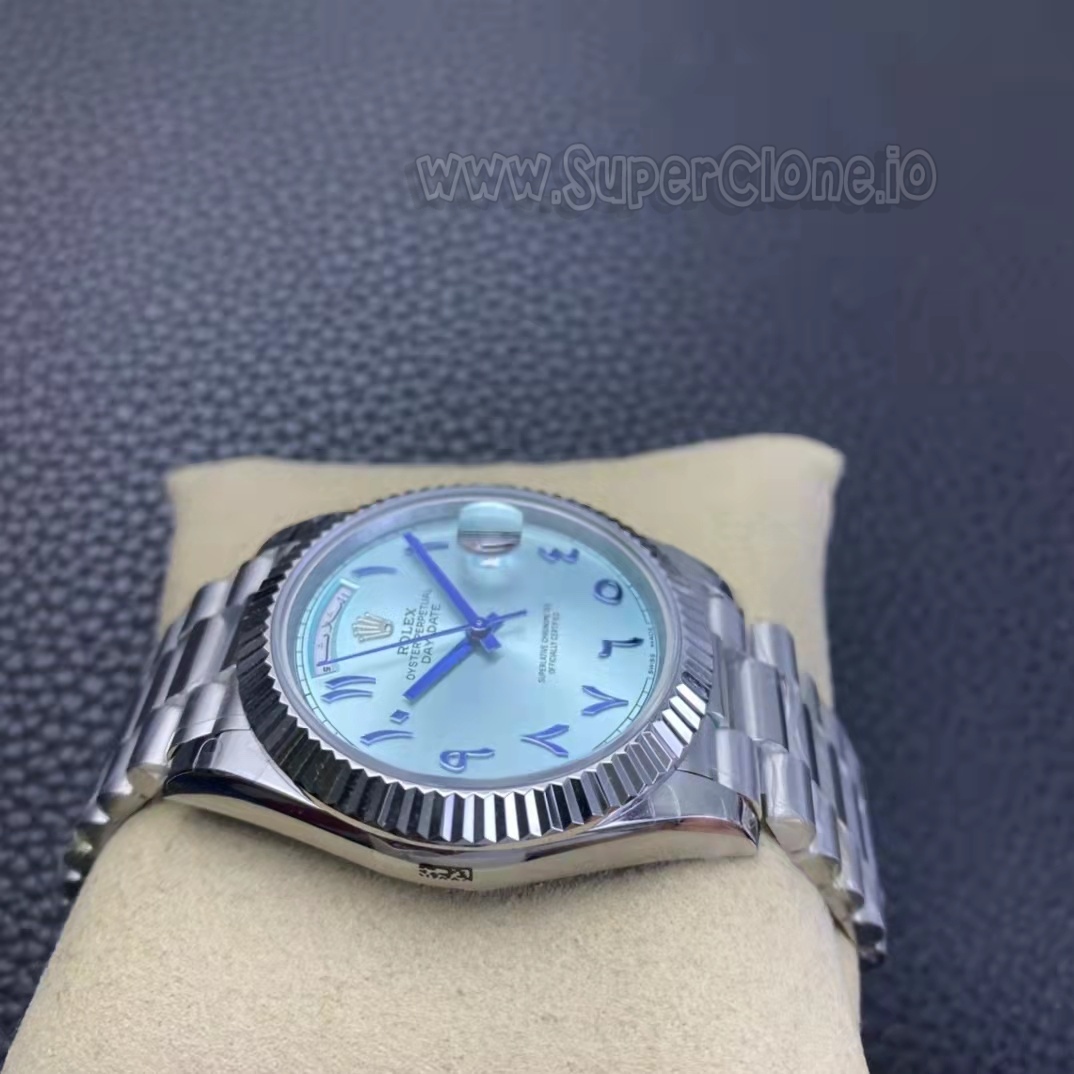
At first glance, the watch immediately feels different from the typical Day-Date replicas seen everywhere online. The combination of an ice blue dial with Arabic hour markers creates a very different personality compared to traditional Roman numeral or baton-marker Day-Date configurations. Instead of looking overly formal or conservative, this version feels more regional and more individualistic, especially because the Arabic day and date display changes the entire visual rhythm of the dial.
One important detail many newer buyers overlook is that Arabic dial replicas are usually much harder for factories to execute cleanly than standard English versions.
With regular Day-Date replicas, small printing imperfections can sometimes disappear visually because collectors are already familiar with the overall layout. Arabic typography introduces an additional layer of scrutiny. Spacing inconsistencies, poor font balance, or weak printing quality become immediately noticeable because the dial itself is the central attraction of the watch. Factories that underestimate this often produce Arabic editions that look attractive in promotional photos but disappointing in person.
GM Factory approached this release more carefully than many people expected.
Recreating the Elusive Platinum Tone
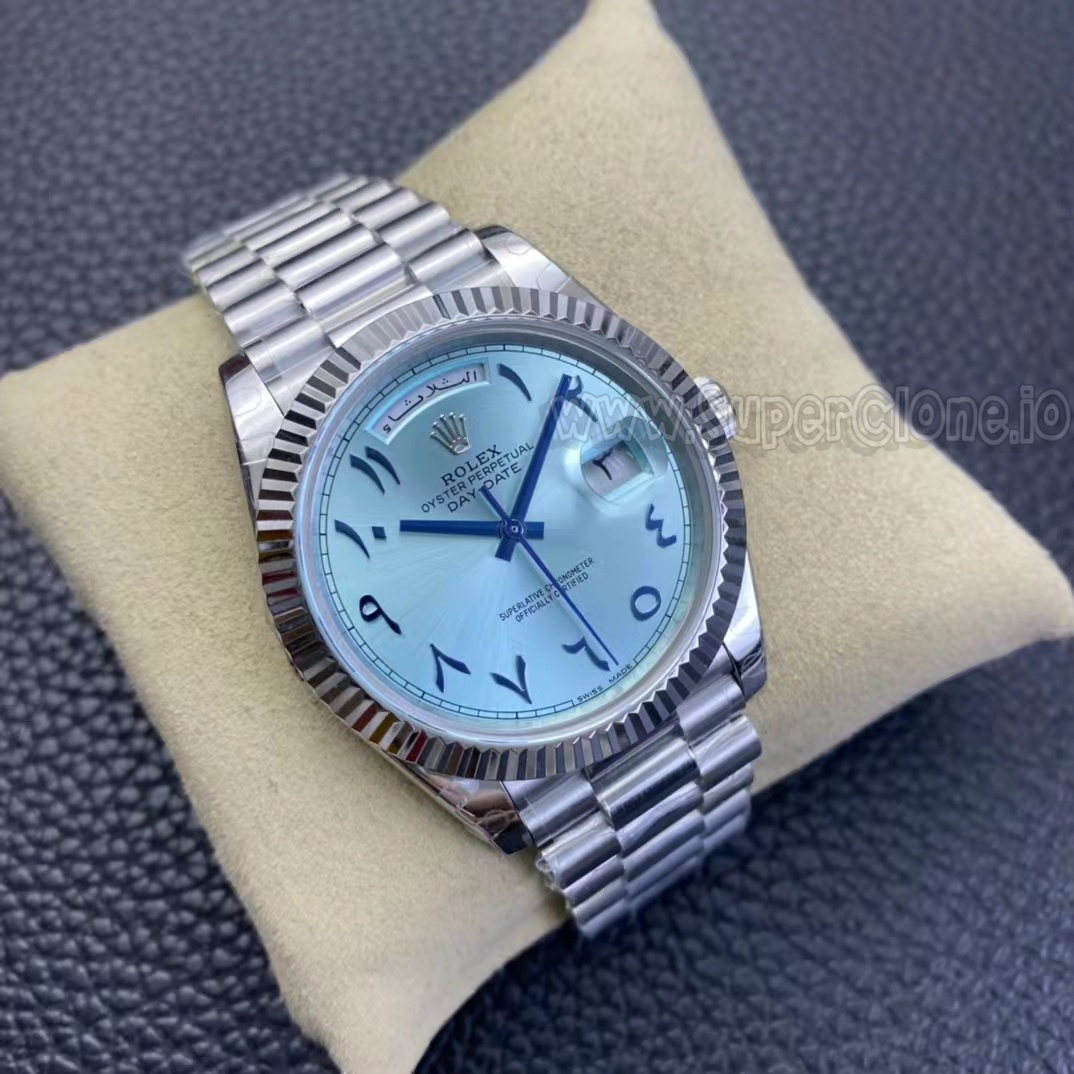
The first thing most collectors notice is the dial color itself. In the genuine Rolex world, ice blue dials are strongly associated with platinum Day-Date and Daytona models. That color carries a certain recognition value because Rolex historically reserves it for precious metal references rather than standard steel sports watches. Replica factories understand this psychological connection very well, which is why ice blue remains one of the most commonly requested dial colors in high-end clone watches.
However, creating a convincing ice blue tone is more complicated than many buyers assume.
Cheap factories often produce dials that look overly saturated or artificially bright under direct lighting. Instead of showing subtle metallic depth, the dial becomes flat and reflective. Better factories attempt to recreate the softer silver-blue appearance that changes depending on light angle. On this GM Day-Date, the color sits somewhere between light blue and cold platinum silver, especially under natural daylight. The sunburst finishing underneath also helps avoid the plastic appearance seen on lower-tier replicas.
The darker blue Arabic markers create enough contrast to keep the dial readable without overpowering the overall tone of the watch. That balance matters because many Arabic numeral layouts can appear visually crowded if the font thickness is excessive.
The 12 O’Clock Arabic Day Wheel Real Estate
Another detail worth discussing is the Arabic day wheel at 12 o’clock aperture window.
Most Day-Date replicas historically struggled with day window alignment. Either the text sat slightly too low, the switching mechanism felt unstable, or the font itself looked incorrect relative to genuine Rolex typography. With Arabic versions, those issues become even easier to detect because the shape complexity of the lettering naturally draws the eye upward.
GM’s implementation here is not perfect under macro inspection, but compared to earlier Arabic Rolex replicas from several years ago, the improvement is substantial. The text alignment appears centered more consistently, and the printing density avoids the faded appearance that plagued older generation day wheels.
Case Geometry and President Bracelet Execution
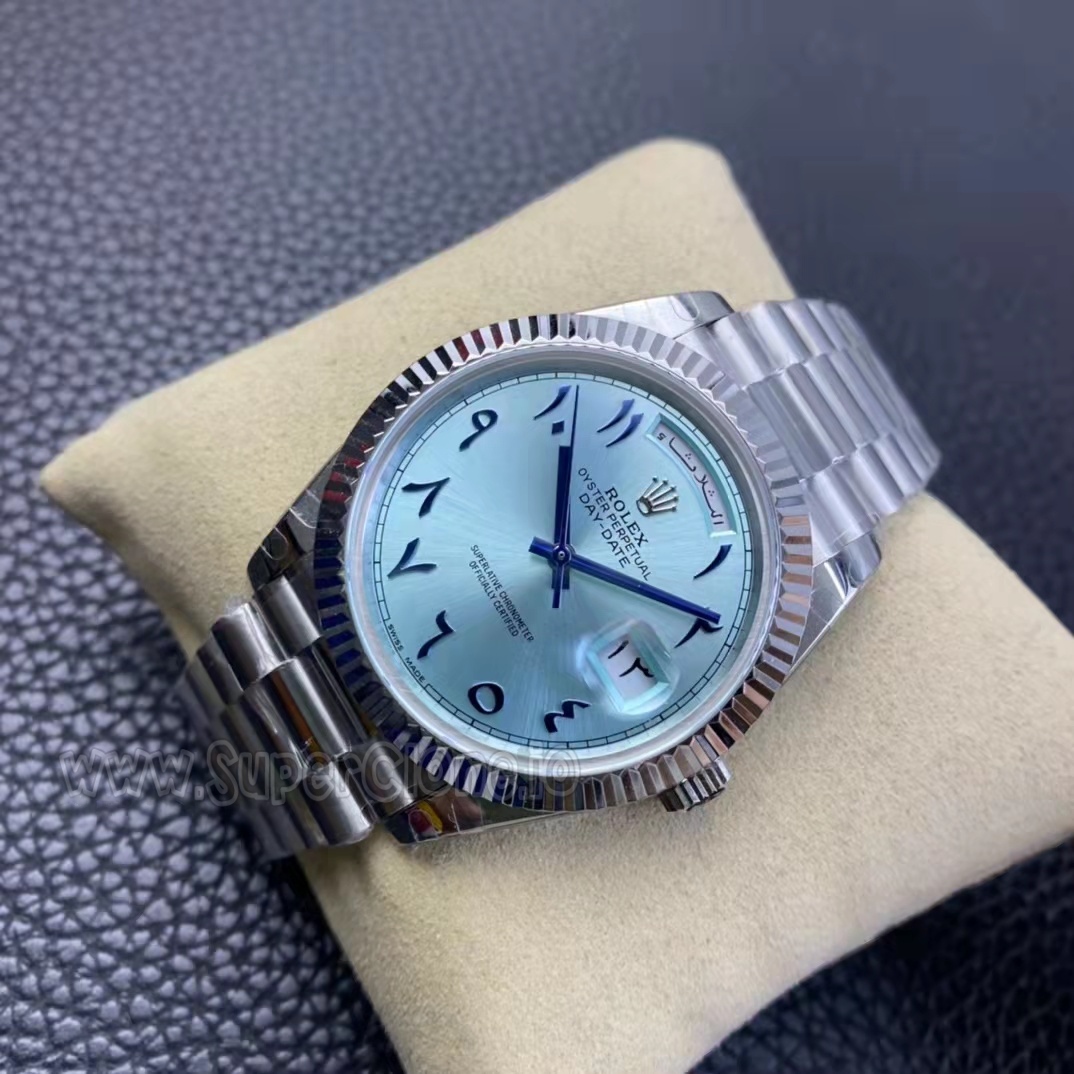
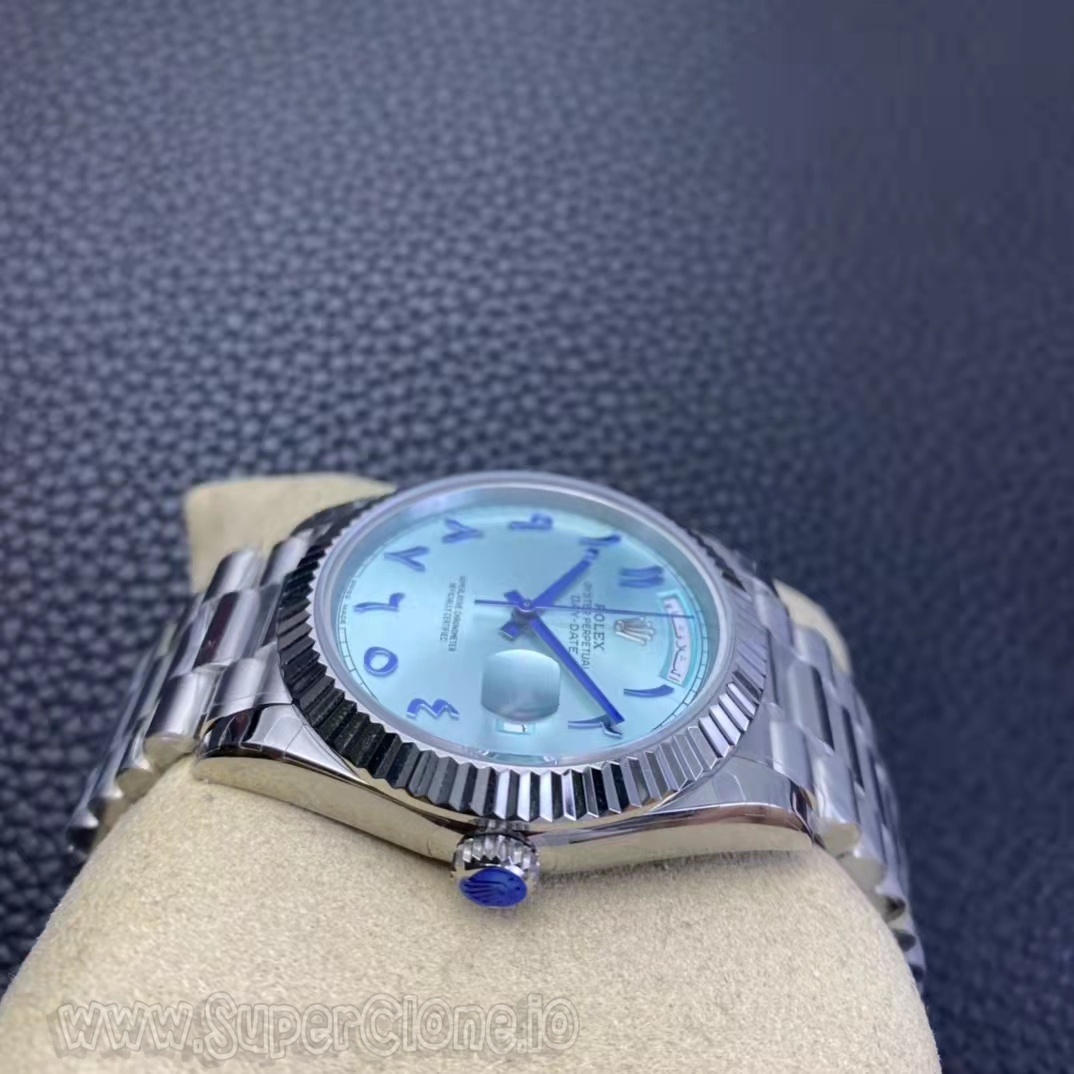
The case construction follows the modern Day-Date 40 proportions that have become standard among higher-end Rolex replicas. GM Factory uses 904L stainless steel for this model, which has become a heavily marketed specification across the replica industry during recent years.
In reality, the importance of 904L steel inside replica watches is often exaggerated by sellers, especially because finishing quality matters far more than the steel classification itself. A poorly finished 904L case will still look inferior to a well-executed 316L watch. What actually matters more is how the case surfaces interact with light, how clean the lug transitions appear, and whether the bracelet integrates naturally into the case geometry.
This is one reason Day-Date replicas are difficult to manufacture convincingly.
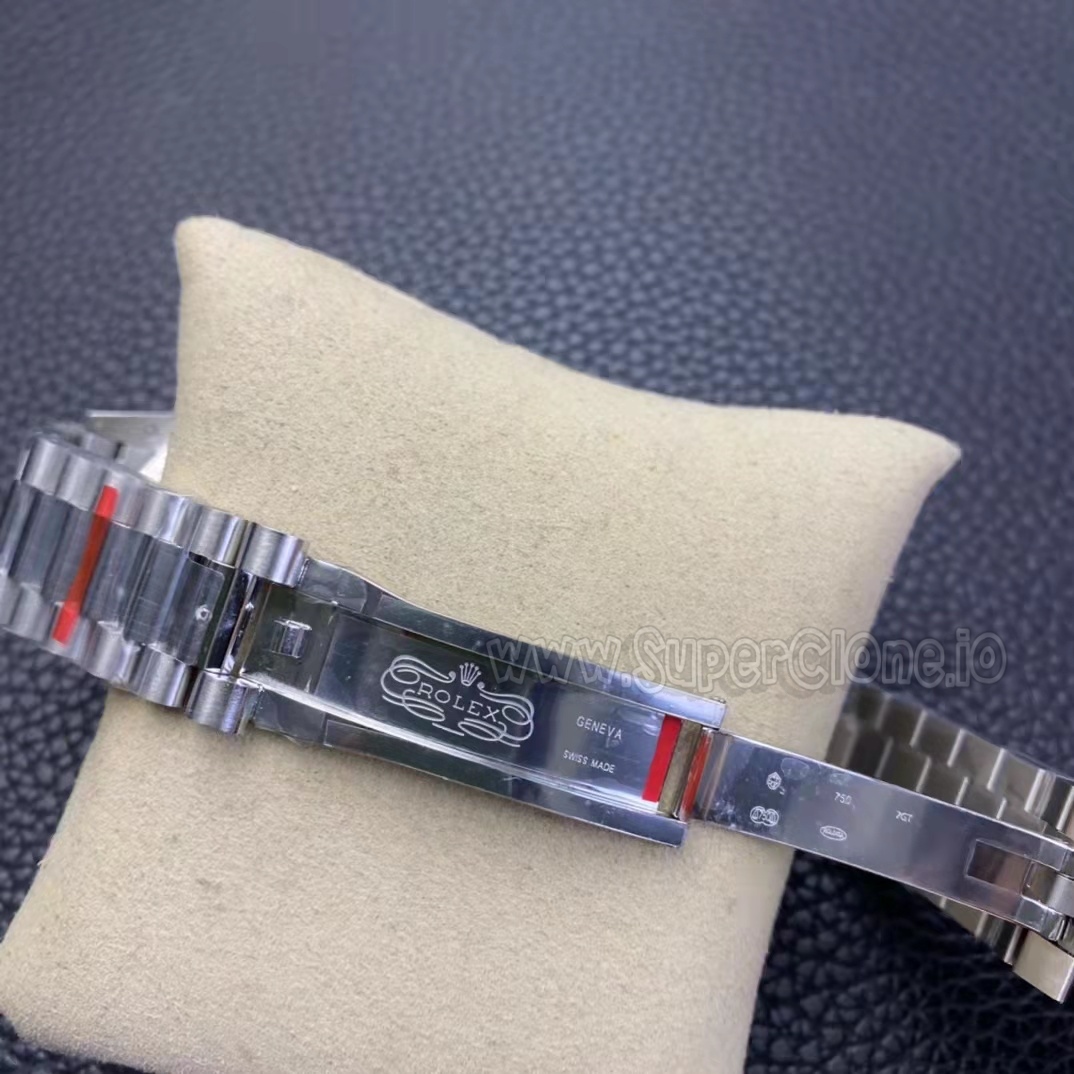
The President bracelet exposes finishing weaknesses immediately. Unlike Oyster bracelets, which have a more tool-watch-oriented character, the President bracelet relies heavily on smooth reflection patterns and polished center links. If polishing consistency is uneven, the watch instantly loses the refined appearance associated with genuine Day-Date models.
GM Factory has spent years refining this area.
Their modern Day-Date bracelets generally feel tighter and more structurally stable than older generation replicas from lesser-known manufacturers. The bracelet drape is improved, the center links reflect light more evenly, and the clasp integration feels less hollow than before. These are small changes individually, but together they significantly affect how the watch feels during actual wear.
Fluted Bezel Reflection Patterns
The fluted bezel also deserves attention because this component often determines whether a replica Day-Date looks convincing at conversational distance.
On lower-quality replicas, fluted bezels frequently appear too sharp, too reflective, or geometrically inconsistent. Genuine Rolex fluting has a very controlled rhythm under light. The reflections should move smoothly instead of appearing chaotic. Factories that overcut the bezel teeth usually produce watches that look visually aggressive rather than elegant.
GM’s bezel finishing has improved noticeably over the last few production cycles. While experienced collectors can still distinguish it from genuine platinum or white gold fluting under close examination, the overall reflection pattern is considerably cleaner than older BP or entry-level Day-Date replicas from previous years.
The polished lugs also work well with the ice blue dial because the cooler tone of the watch naturally benefits from brighter case reflections. Combined with the President bracelet, the watch carries a distinctly Middle Eastern luxury aesthetic that differs from the understated look typically associated with steel Rolex sports models.
Internal Architecture: The Clone 3255 Movement Upgrade
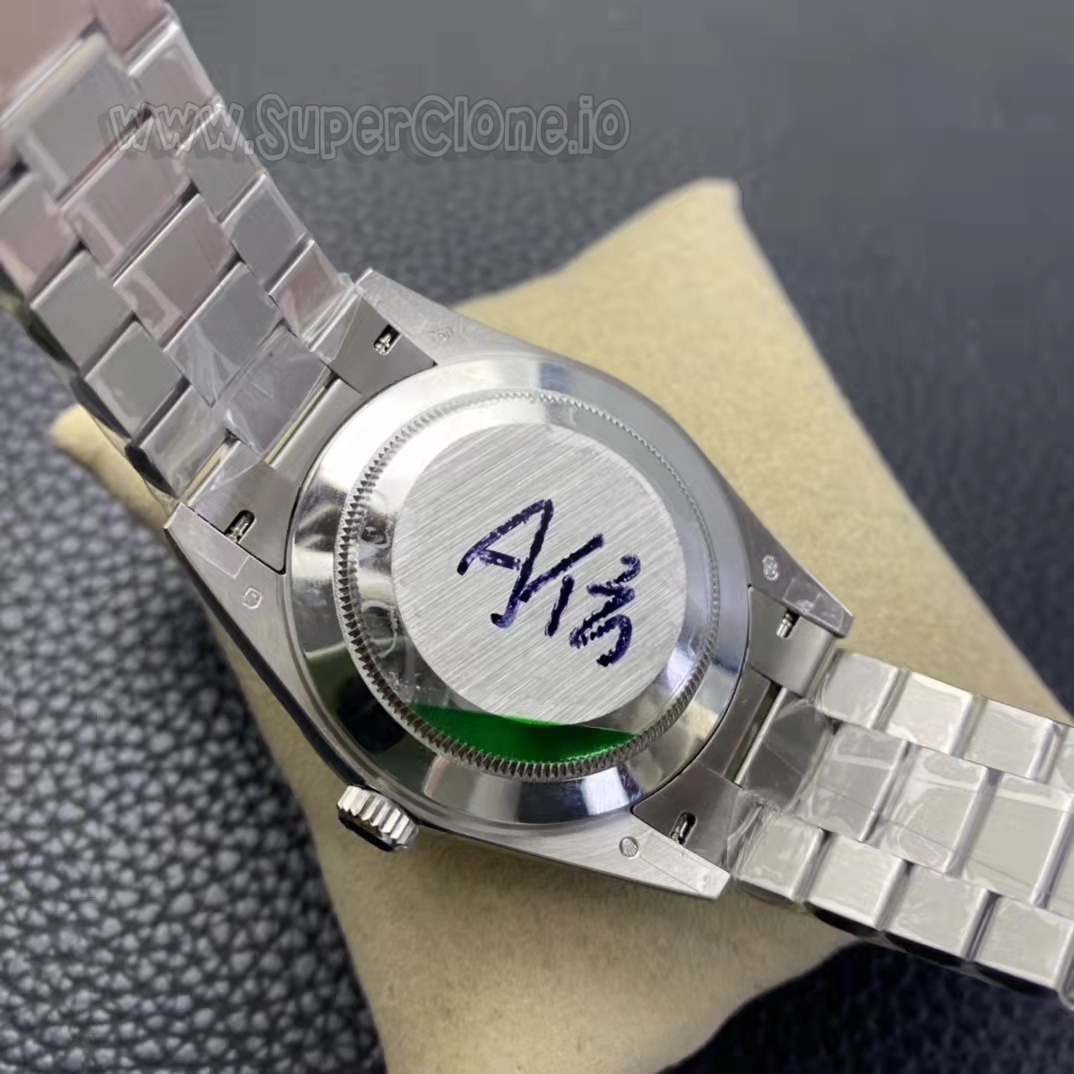
Inside the watch, GM Factory installs a custom-designed clone 3255 automatic movement operating at a steady 28,800 vph beat rate.
This is one of the more important reasons why modern Day-Date replicas feel significantly more advanced than earlier generations.
Years ago, many Day-Date replicas relied on modified Asian ETA-based movements with decorative plates. While those watches could imitate the external appearance reasonably well, the date switching behavior and day wheel mechanics rarely matched the smoothness of genuine Rolex calibers. Power reserve stability was also inconsistent, especially on heavily modified movement platforms.
The emergence of true clone Rolex movements changed the entire market.
Factories began developing calibers that more closely resembled genuine Rolex architecture, not only visually but mechanically. The clone 3255 used by GM is part of that broader transition. Although it is still a replica movement and should not be treated like a genuine Rolex caliber in terms of long-term servicing expectations, it delivers a much more authentic operational experience than older modified movements, providing a practical 48 to 55-hour power reserve profile.
Collectors now pay far more attention to movement correctness than they did several years ago.
That shift is one reason why factories like GM, Clean, VS, and others continue investing heavily in movement upgrades. Modern buyers are no longer satisfied with a visually convincing exterior alone. They expect smoother hand-setting behavior, more accurate date transitions at the stroke of midnight, improved rotor stability, and better overall reliability during daily wear.
For Day-Date replicas specifically, movement quality matters even more because the day complication places additional stress on the calendar mechanism.
Market Maturation and Collector Psychology
Another interesting aspect of this release is how it reflects broader changes inside the replica watch industry after the major factory crackdowns that affected the market several years ago.
When factories like Noob disappeared, many collectors initially assumed the industry would weaken permanently. Instead, the opposite happened in certain categories. Smaller manufacturers started specializing more aggressively. Some focused on crystal upgrades, others on movement refinement, and others on niche references that larger factories previously ignored.
GM Factory gradually positioned itself as one of the more serious Rolex-focused manufacturers during that period.
Rather than trying to dominate every category simultaneously, GM concentrated heavily on Day-Date, Datejust, and certain GMT references. That specialization allowed them to improve details that casual buyers might not notice immediately but experienced collectors appreciate over time. Bracelet tolerances, dial texture consistency, and bezel finishing all improved steadily across multiple production runs.
This Arabic Day-Date reflects that evolution well.
It is not a mass-market replica designed purely around broad commercial appeal. It targets a narrower audience that specifically wants something different from the standard black dial Daytona or green Submariner formula dominating most replica discussions online.
That difference matters because the super clone market has matured considerably.
Several years ago, collectors mainly searched for the “closest to genuine” option available regardless of reference variety. Today many buyers already own multiple mainstream replicas. They are increasingly interested in watches that feel less common, more regionally distinctive, or visually different from the standard configurations everyone recognizes immediately.
Arabic dial Rolex replicas fit naturally into that trend.
The Realities of Wearing a Niche Luxury Variant
There is also a collector psychology element behind watches like this that rarely gets discussed openly.
A traditional stainless steel Submariner replica tries to disappear into familiarity. Most people recognize the design instantly. The appeal comes from closeness to the original. An Arabic Day-Date works differently. It attracts attention precisely because it looks less familiar. Even people who know Rolex watches well may pause briefly when seeing Arabic day wheels and ice blue configurations together.
That creates a completely unique wearing experience.
The watch feels less like a direct imitation of a mainstream luxury icon and more like a niche regional variant that exists slightly outside ordinary Rolex expectations. Whether intentional or not, that uniqueness is part of the attraction.
Of course, no replica watch is perfect.
Buyers expecting genuine platinum weight, authentic Rolex finishing under magnification, or factory-level movement durability will always encounter limitations. Super clone watches have improved dramatically, but they still exist within practical manufacturing constraints. The value proposition comes from how convincingly factories recreate the overall ownership experience relative to cost, not from literal equivalence to genuine Swiss production standards.
Within that context, this GM Factory Arabic Day-Date is one of the more interesting modern Day-Date replicas currently circulating in the market.
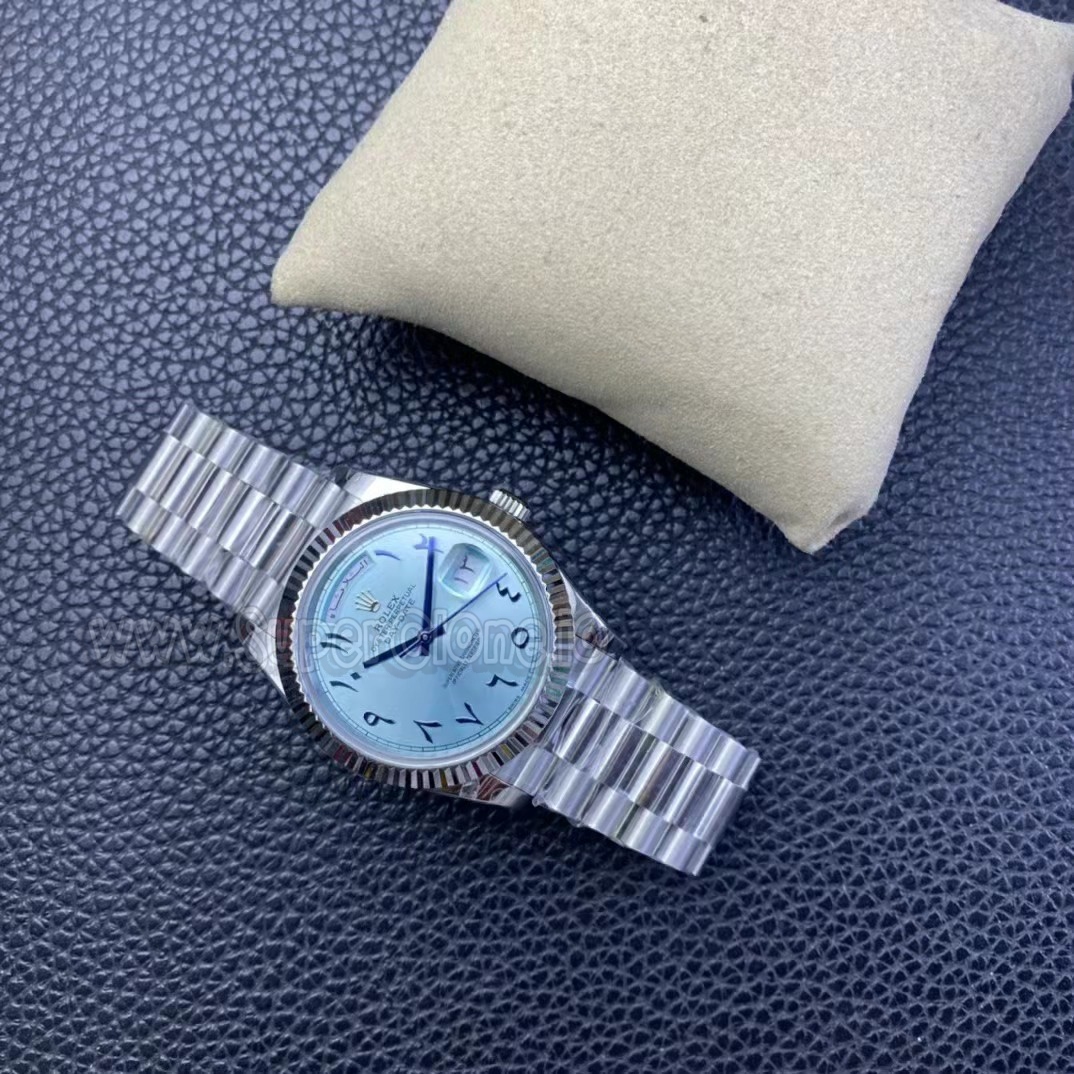
What makes it memorable is not simply the Arabic numerals or the ice blue dial individually. It is the combination of multiple details working together: the colder platinum-style color palette, the regional typography, the President bracelet architecture, the clone 3255 movement, and the fact that the watch does not resemble the standard Rolex replicas most collectors already own.
That is increasingly where the replica industry appears to be heading.
The next stage of competition is no longer just about whether factories can reproduce a Submariner or Daytona accurately. Most major factories can already do that competently. The real differentiation now comes from niche execution, movement refinement, specialized dial production, and how convincingly factories recreate references that previously existed only in small collector circles.
