
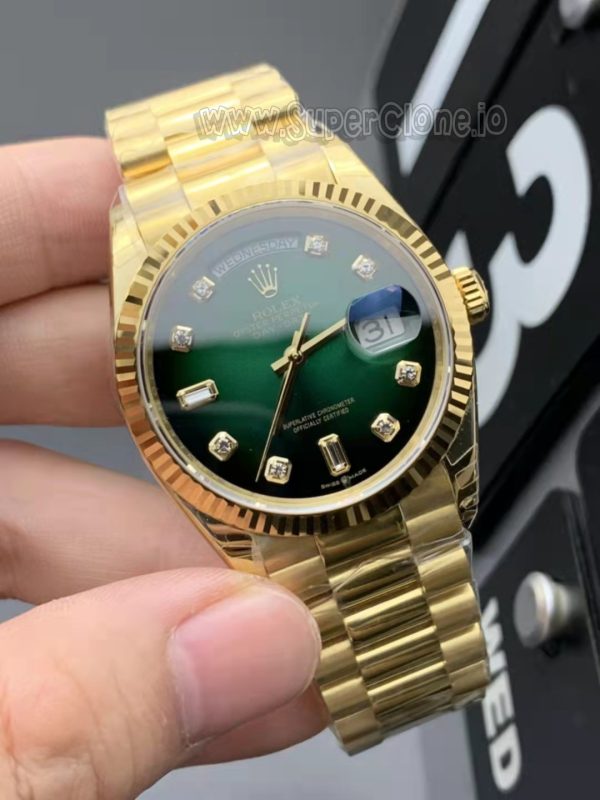
EW Factory Rolex Day-Date 36mm Green Dial Review Inside the Rise of Modern Mid Tier Rolex Replicas
The replica Rolex market changed significantly after major factory disruptions affected supply chains. Before that period, most buyers focused on a few established names. If a Rolex replica was not produced by factories like Noob, ARF, GMF, or VSF, it was often ignored without detailed inspection. The market was highly centralized. Buyers prioritized the “top factory” label over studying the watch itself. However, when shipping slowed, raids interrupted production, and some large factories ceased consistent operation, smaller manufacturers gained attention. EW Factory (EWF) emerged as a notable example.
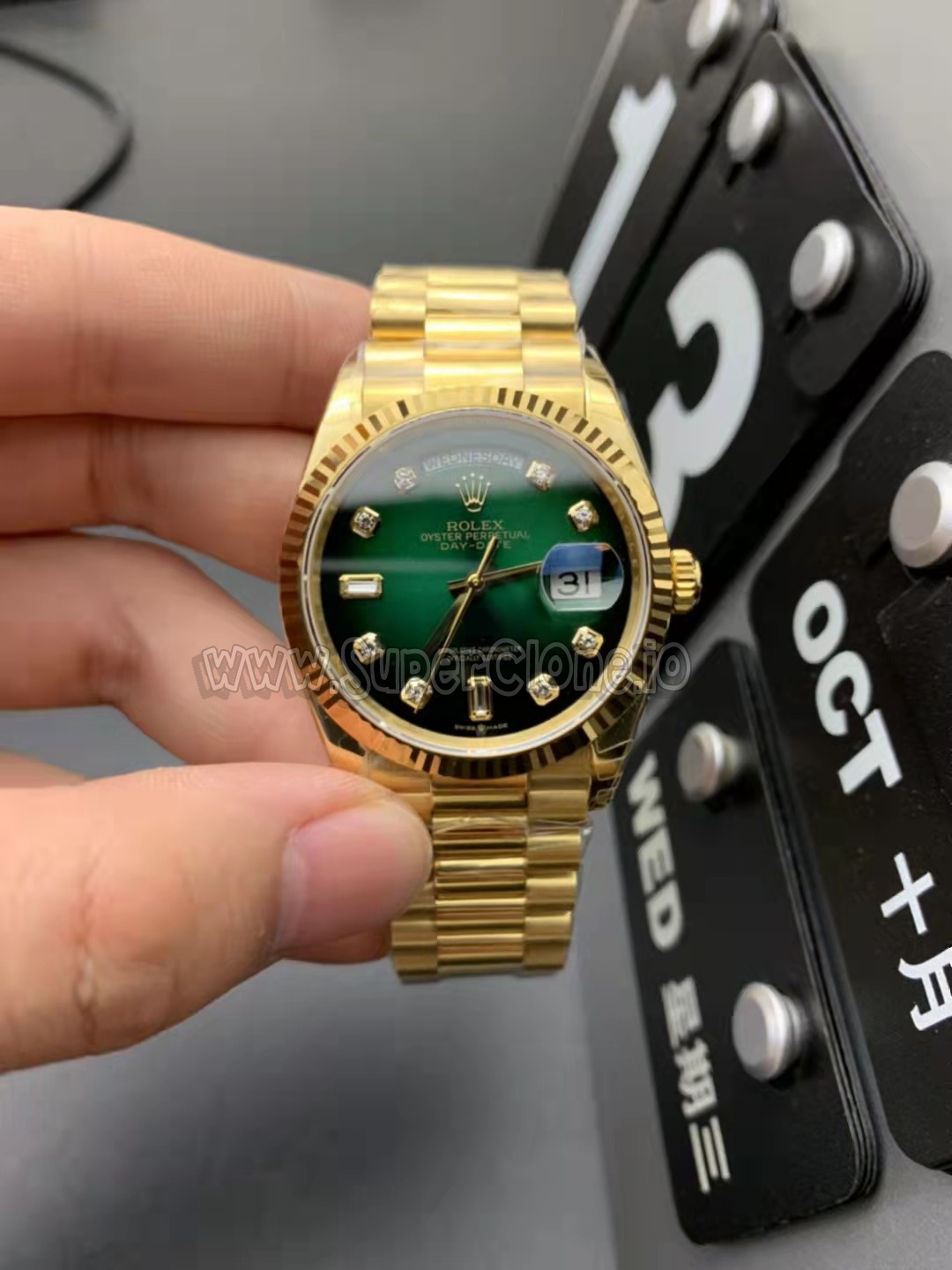
EW became relevant not because it suddenly produced the most technically advanced Rolex replicas, but because it aligned with a shifting buyer mindset. When supply chains become unstable, buyers prioritize consistency, appearance, and delivery reliability over marginal improvements in movement fidelity. In this context, the Day-Date 36mm yellow gold with green dial became one of EW’s most recognizable configurations.
First Impressions: Green Dial Visual Identity
The yellow gold and green combination immediately distinguishes this Day-Date from more conservative configurations. While traditional replicas often replicate champagne or silver dials, this version is visually more expressive. The green tone creates a clear contrast against the gold case and President bracelet, producing stronger visual separation under both natural and indoor lighting conditions.
Compared with champagne-dial Day-Date replicas from GMF or earlier Noob-era stock, EW’s green dial configuration offers noticeably higher “on-wrist visibility.” This is particularly relevant in real-world use, where wrist perception matters more than macro inspection.
Dial Execution: The Gradient That Changed Perceptions
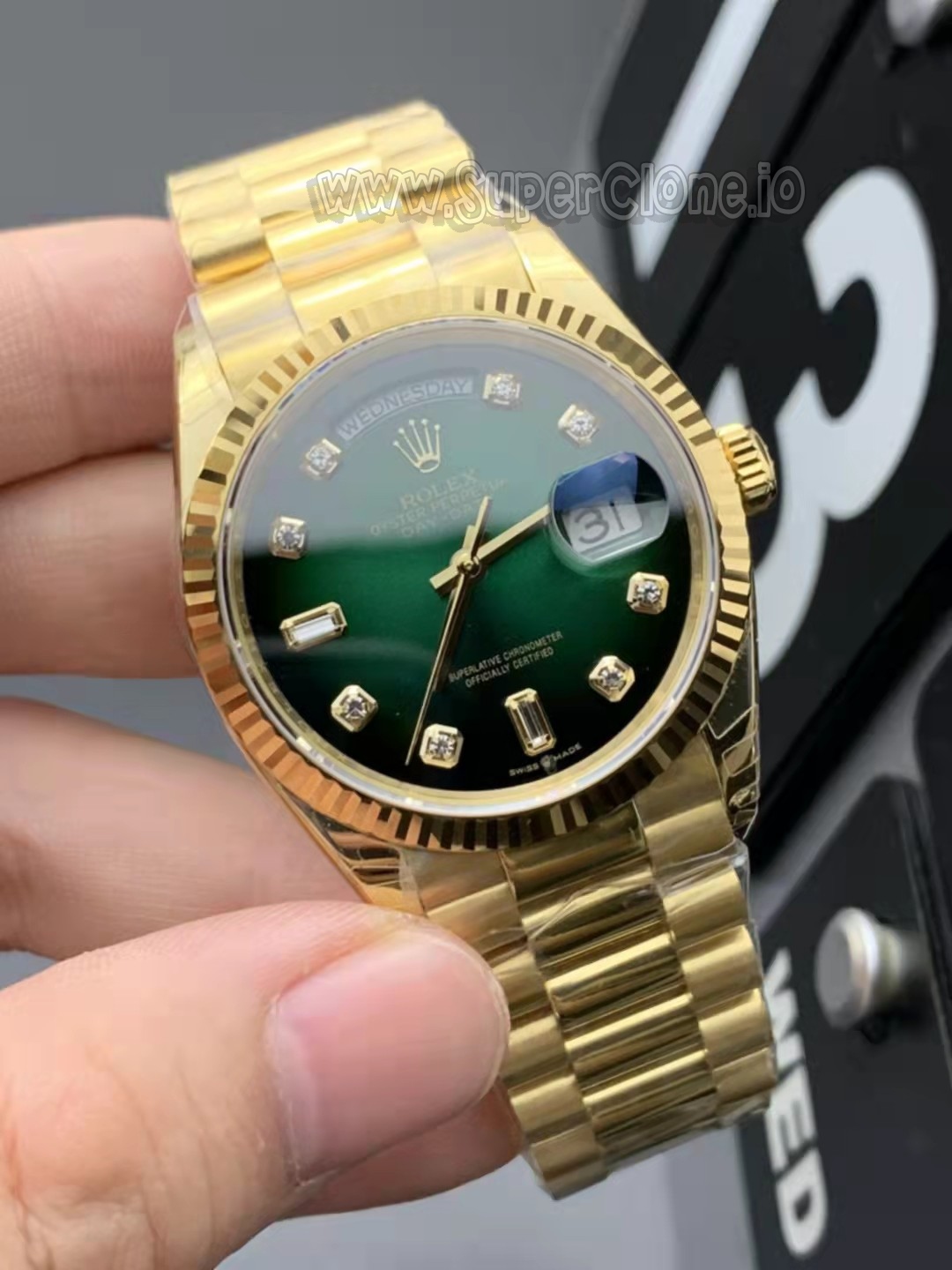
The gradient green dial is the defining feature of this configuration. In lower-tier replicas, gradient transitions often collapse under lighting, producing flat or uneven coloration. EW examples generally show a workable radial gradient from a brighter center to a darker periphery, with moderate sunburst dispersion that remains visible under indoor LED lighting.
Under closer inspection (approximately 5x magnification), the applied Rolex crown logo is slightly thicker than genuine executions, especially at the crown tips. However, alignment consistency across EW batches is relatively stable, with minor variations appearing mainly in older production runs. The minute track spacing is acceptable at normal viewing distance but lacks the razor-level precision found in GMF or VSF-grade finishing ecosystems.
From a production standpoint, EW does not attempt to replicate Rolex dial manufacturing complexity. Instead, it focuses on macro visual fidelity—ensuring the watch “reads correctly” at 30–80cm viewing distance, which is the dominant real-world use case.
Case, Crown Profile, and 36mm Proportions
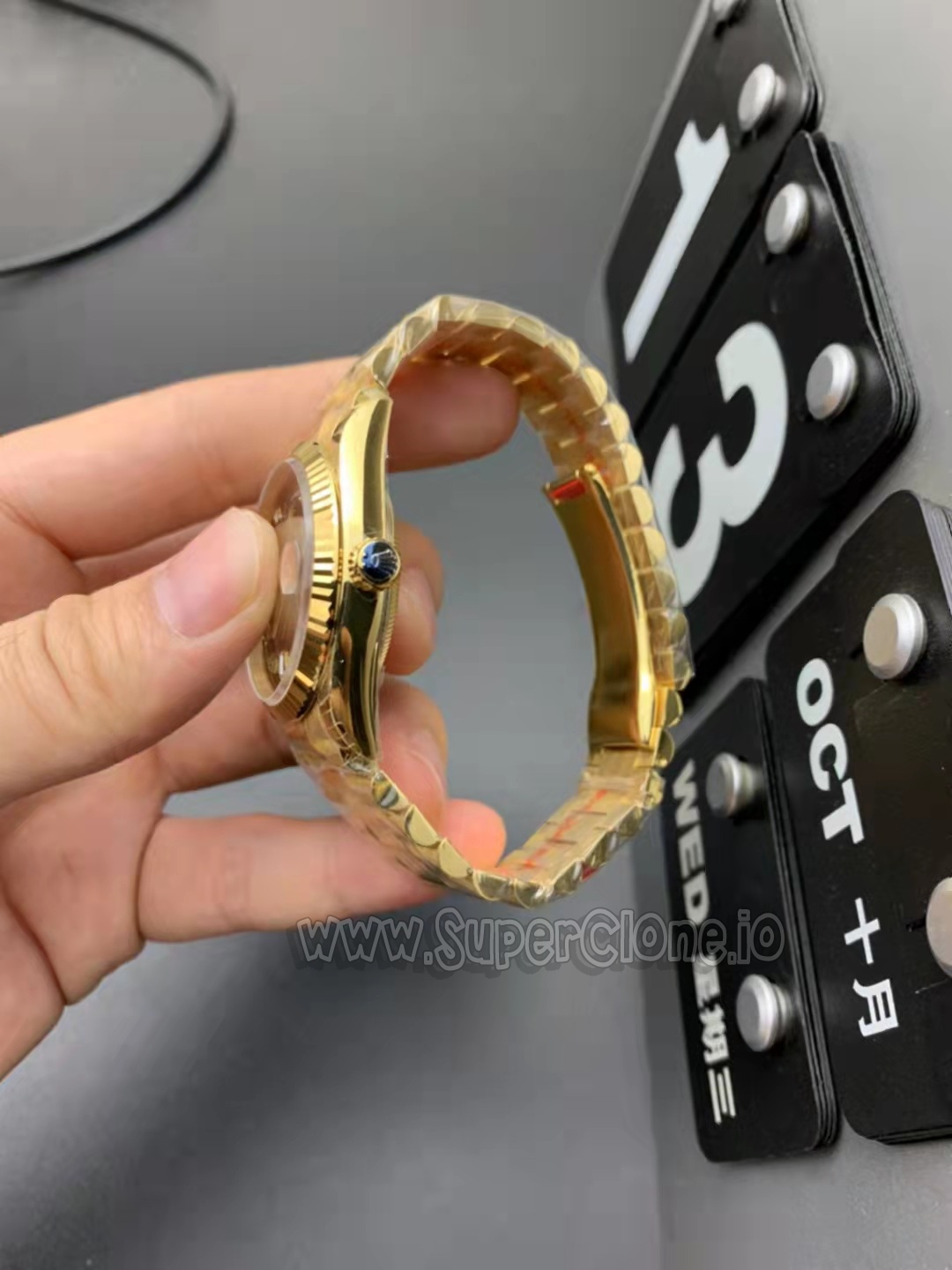
The 36mm Day-Date remains one of the most proportionally balanced Rolex designs. EW preserves this geometry without inflating case dimensions, which is a common issue in entry-level replicas that often exceed 36.5–37mm in actual measurement.
Measured across multiple EW examples, case dimensions typically fall within 35.9–36.2mm. Thickness ranges from 11.9mm to 12.3mm depending on crystal seating and caseback compression. Lug-to-lug measurements remain stable at approximately 43mm, which contributes to consistent wrist ergonomics across different production batches.
Weight distribution is one of the more interesting aspects of this model. Most EW Day-Date 36 units fall between 125g and 135g depending on bracelet sizing and clasp configuration. This places it slightly lighter than higher-end fully solid-link replicas from GMF/QF, but still within a believable “precious metal presence” range on wrist.
EW Factory Day-Date 36mm Key Specifications
| Specification Component | EW Factory Execution Details |
|---|---|
| Case Diameter | 35.9–36.2mm (batch variance controlled) |
| Case Thickness | 11.9–12.3mm |
| Lug-to-Lug | ~43mm stable across batches |
| Weight | 125–135g (bracelet-dependent) |
| Base Material | 316F stainless steel (mid-tier finishing grade) |
| Gold Coating | Approx. 5μm electroplating (mid-tier standard range) |
| Dial Style | Green sunburst gradient (~30mm aperture) |
| Bezel Type | Fluted yellow gold plated bezel |
| Bracelet | President bracelet, semi-solid links, 20mm lug width |
| Movement Type | Asian 3255 clone (40–42h power reserve, ±8–15s/day observed range) |
| Hour Markers | Crystal-set indices (non-gemstone production standard) |
Compared with GMF and QF executions, EW’s finishing priority is clearly different. GMF tends to emphasize tighter tolerances and sharper bezel geometry, while QF often produces slightly heavier case assemblies with improved material density perception. EW instead focuses on maintaining acceptable visual coherence across dial, bezel, and bracelet without pushing into higher-cost finishing tiers.
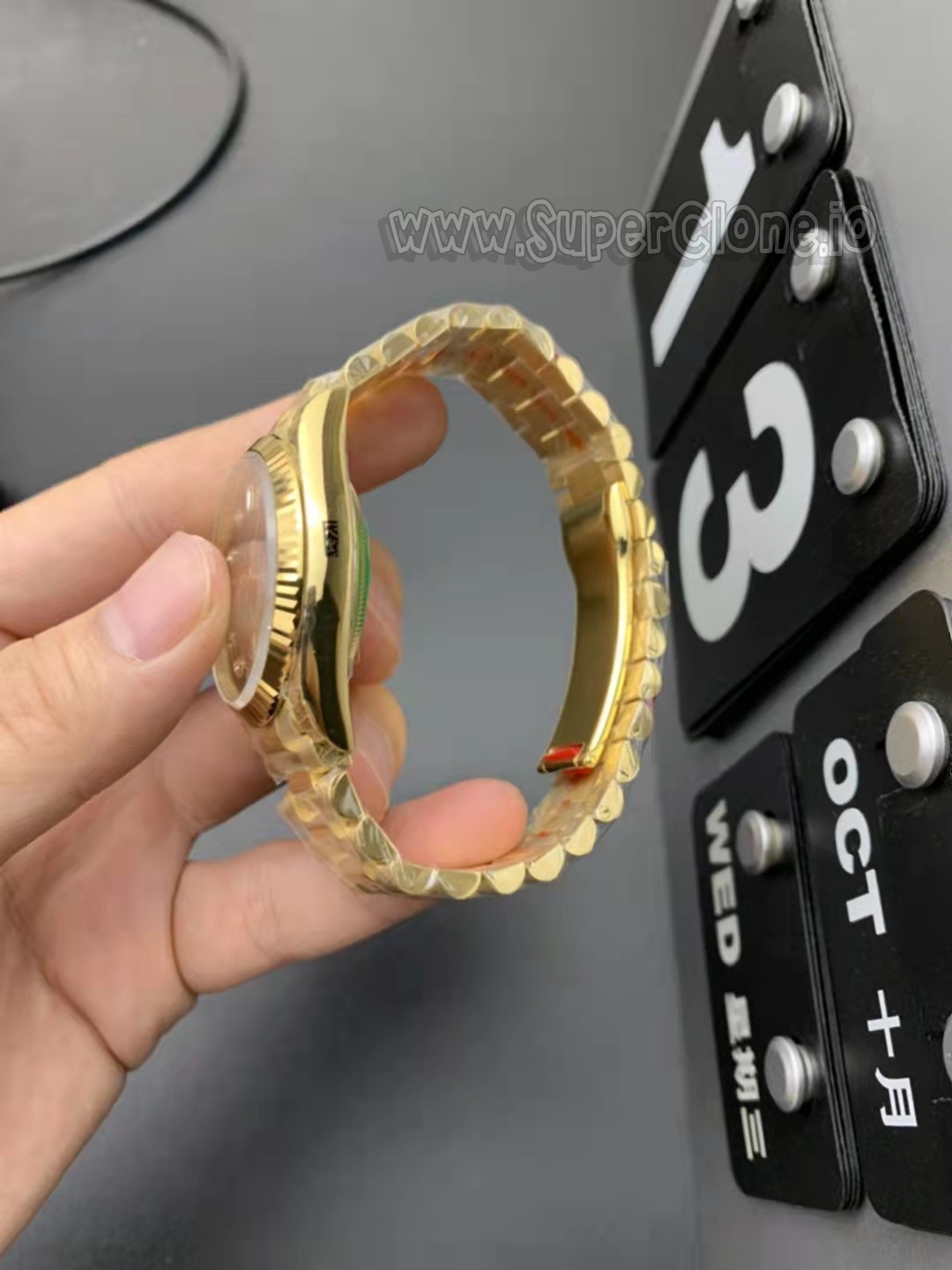
Bezel and Bracelet Execution: Where Mid-Tier Replicas Win or Lose
The fluted bezel exhibits moderate sharpness with balanced light dispersion. It does not reach GMF-level crispness under macro inspection, but avoids the overly rounded geometry commonly seen in entry-tier replicas. Edge definition remains stable across most lighting conditions, particularly under daylight exposure.
The President bracelet remains one of EW’s strongest elements. Link articulation is consistent, with reduced lateral stiffness compared to budget-tier models. In practical wear testing, bracelet flex behavior closely approximates genuine Rolex “drape effect” at wrist level, although micro-gap tolerances between links are still slightly wider than GMF/QF benchmarks.
Clasp closure produces a soft snap engagement, though without the ultra-refined resistance curve found in higher-tier factories. This places EW firmly in the mid-tier usability bracket rather than luxury-grade tactile refinement.
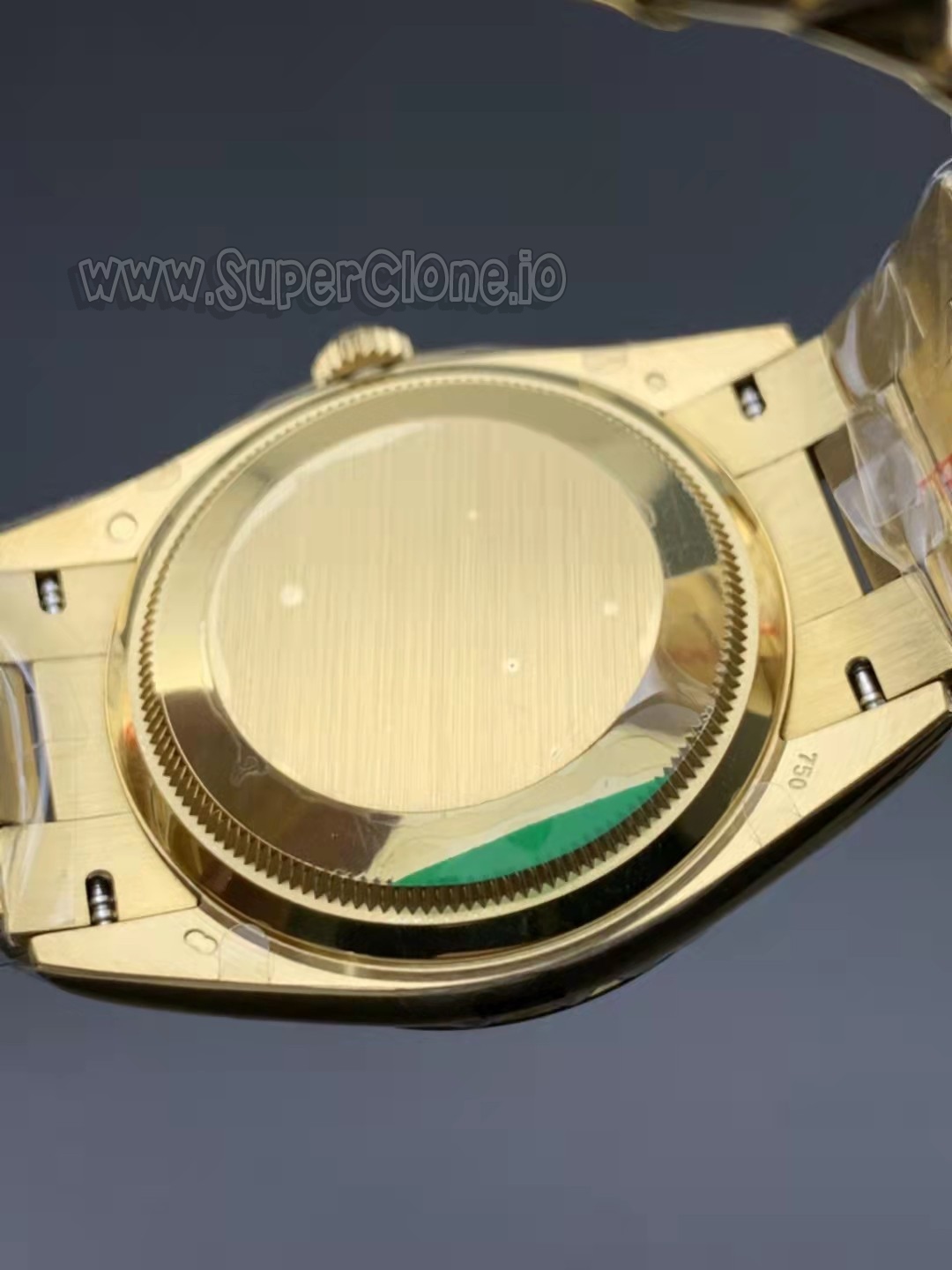
Case Back and Dial Furniture Details
The closed case back design remains consistent with Rolex Day-Date architecture philosophy, prioritizing external presentation rather than movement exhibition. Surface finishing is clean but not deeply engraved, reflecting cost-controlled machining standards.
Dial markers use crystal-style inserts rather than genuine gemstones. Light reflection is uniform but lacks the internal dispersion complexity found in real diamond cuts. However, at normal viewing distance (30–50cm), the visual distinction becomes significantly less noticeable, which explains why these configurations remain popular in real-world usage.
Observation: EW dial execution prioritizes perceptual correctness over microscopic perfection. This design philosophy is consistent across most mid-tier factories operating under cost-sensitive production constraints.
Color Combination Success: Green and Yellow Gold as a Strategic Choice
The green and yellow gold combination improves visual segmentation across the dial plane, especially under warm indoor lighting where gold surfaces typically compress tonal contrast. The green dial introduces necessary separation, preventing the watch from appearing visually flat.
Compared to champagne-dial variants, this configuration also performs better in digital photography environments, where contrast and saturation directly influence perceived luxury value in social media contexts.
Real World Wrist Experience
On a 6.5–7 inch wrist, the 36mm profile maintains balanced proportions without overextension beyond lug boundaries. The case sits flat due to moderate thickness (~12mm), allowing comfortable cuff clearance in formal wear situations.
Long-term wear testing indicates minimal fatigue during extended daily use. Weight distribution remains centered, with no significant top-heaviness despite plated gold construction. Compared to 40mm Day-Date variants, the 36mm configuration provides noticeably better long-duration comfort, particularly in office environments.
Inside the Movement: Asian Clone 3255
The movement architecture is based on an Asian 3255 clone platform with decorative modification layers. It is not a full structural reproduction but a functional approximation optimized for cost-performance balance.
Observed performance typically falls within 40–42 hours of power reserve, with daily deviation ranging between ±8–15 seconds depending on regulation quality and wearing habits. Calendar switching remains reliable under normal operating conditions, although instantaneous date alignment precision is not equivalent to higher-grade clone calibres.
Market Context: Why EW Gained Visibility During Disruptions
EW’s market relevance is strongly tied to supply chain disruption cycles, where buyer behavior shifted toward availability-driven decision-making. Instead of competing at the highest technical level, EW occupied a functional mid-zone defined by visual correctness, accessibility, and acceptable mechanical reliability.
This positioning allowed EW to maintain visibility even when higher-tier factories experienced inconsistent output or restricted distribution channels.
How Does EW Compare Against GMF, QF, and BPF?
Within the Day-Date replica hierarchy, EW occupies a clearly defined mid-tier position:
- GMF: superior finishing precision, tighter bracelet tolerances, more refined bezel geometry.
- QF: stronger perceived mass, improved case density feel.
- BPF: competitive pricing but inconsistent dial execution across batches.
- EW: best balance of availability, acceptable finishing, and visual correctness under mid-tier pricing constraints.
EW does not aim to compete at the highest fidelity level. Instead, it optimizes for consistent visual satisfaction across a broader buyer base.
What the EW Day-Date Represents in the Replica Rolex Market
The EW Factory Rolex Day-Date 36mm green dial represents a structurally important mid-tier segment within the replica ecosystem. It prioritizes external identity accuracy and practical ownership experience over mechanical depth or high-end finishing precision.
Its significance lies less in technical superiority and more in timing and positioning. During periods of factory instability, this balance became more relevant than marginal improvements in engineering fidelity.
As a result, EW occupies a durable niche as a visually coherent, moderately refined, and widely accessible interpretation of one of Rolex’s most recognizable designs.
